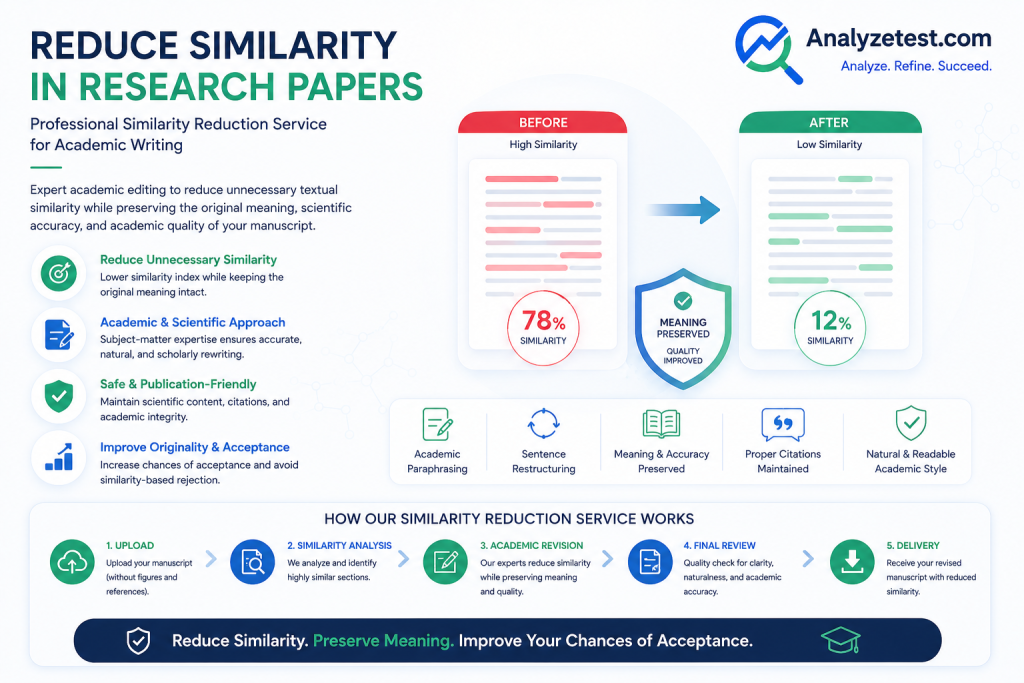
Professional Similarity Reduction Service for Academic Writing
Expert academic editing to reduce unnecessary textual similarity while preserving the original meaning, scientific accuracy, and academic quality of your manuscript.
Upload your manuscript below (without figures and references) to request a professional similarity reduction review.
If you encounter any problems with the upload or submission, please contact us at analyzetest.info@gmail.com.
Manuscript Similarity Reduction: A Complete Guide
1. Introduction
Manuscript similarity is an important consideration when preparing a scientific paper for journal submission. Before a manuscript is accepted, many journals use similarity-detection software to identify textual overlap between the submitted manuscript and previously published articles, theses, conference papers, websites, and other publicly available sources. A high similarity score may lead to additional questions from editors or reviewers, particularly when substantial overlap occurs in important sections of the manuscript.
However, a similarity score is not the same as plagiarism. Scientific manuscripts naturally contain technical terminology, standard methodological expressions, commonly used phrases, and descriptions that may resemble previously published literature. Therefore, similarity reports should be interpreted carefully rather than treated as a simple measure of originality.
In some cases, unnecessary textual overlap can be reduced through appropriate academic rewriting. This may involve restructuring sentences, improving the organization of ideas, replacing repetitive expressions, and rewriting passages in a more natural and original academic style while preserving the underlying scientific meaning.
At AnalyzeTest, our Manuscript Similarity Reduction Service focuses on legitimate academic rewriting rather than simply replacing individual words with synonyms. The objective is to improve the originality and readability of the language while maintaining the accuracy of scientific statements, technical terminology, numerical values, experimental conditions, and intended interpretation.
This distinction is particularly important for technical manuscripts. Scientific writing cannot be rewritten as ordinary general-purpose text because changing a technical term or modifying the structure of a scientific statement incorrectly may alter its meaning. Effective similarity reduction therefore requires an understanding of both academic English and the scientific subject of the manuscript.
Our approach combines scientific expertise, technical understanding, academic language improvement, and human review to identify unnecessary textual overlap and revise appropriate sections while maintaining the integrity of the research.
Importantly, no legitimate similarity-reduction service should promise a specific final similarity percentage in every case. The final score depends on the manuscript, its field, the database used by the journal’s similarity software, references and standard terminology, and the software’s matching criteria. The goal should therefore be to produce a genuinely well-written and appropriately original manuscript—not to manipulate a software score.
Whether you need to revise an entire manuscript or only selected sections such as the Abstract, Introduction, Results and Discussion, or Conclusion, professional similarity reduction can help improve the originality, readability, and overall presentation of your scientific writing while preserving its technical content.
2. What Is Manuscript Similarity?
Manuscript similarity refers to the degree of textual overlap between a submitted manuscript and content that already exists in other documents or sources. Similarity-detection systems compare the wording of a manuscript against large databases containing published scientific articles, theses, dissertations, conference papers, websites, and other indexed content. The software then identifies passages that share similar or identical wording and presents the results in a similarity report.
A similarity score is usually expressed as a percentage. For example, a report showing 18% similarity means that the software has identified text within the manuscript that overlaps with material in its comparison database according to its matching criteria. It does not automatically mean that 18% of the manuscript is plagiarized.
Similarity Is a Textual Measurement
Similarity software primarily identifies textual overlap. It does not independently determine whether an author has committed plagiarism.
For example, the following may legitimately produce similarity:
- Standard scientific terminology
- Common methodological descriptions
- Names of chemical compounds
- Established scientific expressions
- Equations and mathematical terminology
- Conventional descriptions of experimental procedures
- Properly cited statements
- Bibliographic information
- Text from the authors’ own previously published work
Therefore, a similarity report must be interpreted in its scientific and publishing context.
How Is a Similarity Score Generated?
Although different systems use different algorithms and databases, the general process involves comparing the submitted text with existing sources and identifying matching or closely related passages.
The resulting report may show:
Overall similarity percentage
Individual matching sources
Highlighted matching passages
Percentage associated with each source
The software may also provide options for excluding certain material, such as references or very short matches. Consequently, the same manuscript can produce somewhat different similarity scores depending on the software, database, settings, and exclusions used.
A High Similarity Score Does Not Automatically Mean Plagiarism
This is one of the most important points for researchers.
A manuscript with a relatively high similarity score may contain legitimate overlap, while a manuscript with a relatively low overall score may still contain an inappropriate unattributed passage.
For example, a paper could have a 25% similarity score largely because of:
- Standard Materials and Methods language
- Common technical terminology
- Properly cited literature
- References
- Short phrases distributed throughout the manuscript
Conversely, a relatively small amount of copied text from a specific source may require attention if it represents substantial unattributed use of another author’s original wording or ideas.
Therefore, the individual matching passages and their sources are often more informative than the overall percentage alone.
Similarity Can Occur Naturally in Scientific Writing
Scientific communication relies on established terminology and conventional ways of describing experiments.
For example, expressions such as:
“The samples were washed several times with distilled water and dried at 60 °C.”
may resemble descriptions found in numerous scientific papers because there are only limited natural ways to describe a routine experimental procedure.
Similarly, technical terms such as:
- electrochemical impedance spectroscopy
- charge-transfer resistance
- Fourier-transform infrared spectroscopy
- X-ray diffraction
- corrosion inhibition efficiency
cannot simply be replaced with unusual alternatives merely to make the text appear different.
Good similarity reduction therefore does not mean changing every phrase that resembles another publication.
Similarity in Different Sections of a Manuscript
The amount and type of similarity can vary substantially between manuscript sections.
Introduction:
Similarity may result from commonly used descriptions of established scientific concepts or research background.
Materials and Methods:
This section can naturally contain relatively high overlap because experimental procedures often require standardized technical descriptions.
Results and Discussion:
Original interpretation generally provides more opportunities for distinctive scientific writing, although terminology and descriptions of established concepts may still overlap.
Conclusion:
Similarity is often lower, but conventional scientific expressions may still appear.
The appropriate strategy should therefore depend on where the similarity occurs and why it occurs.
Similarity Reports Should Be Interpreted, Not Simply Reduced
The purpose of reviewing a similarity report is not to blindly reduce the percentage.
Instead, each important match should be evaluated:
- What source produced the match?
- How much text overlaps?
- Is the source properly cited?
- Is the wording conventional or distinctive?
- Does the passage need rewriting?
- Would rewriting change the scientific meaning?
This approach produces a more scientifically responsible manuscript than simply replacing words until a target percentage is reached.
Similarity and Originality
A manuscript can have textual similarity while still making an original scientific contribution. Originality in research may arise from:
- A new material
- A new synthesis strategy
- A new experimental approach
- A new application
- New experimental data
- A new interpretation
- A new mechanism
- A new theoretical or computational approach
Therefore, textual similarity should not be confused with the overall scientific novelty of the research.
Why Professional Interpretation Matters
Similarity reports can be misleading when interpreted without considering the scientific context. A researcher may unnecessarily rewrite legitimate technical expressions or, alternatively, overlook an important problematic passage simply because the overall similarity percentage appears acceptable.
A professional similarity review focuses on meaning, context, source, and scientific relevance, rather than treating the percentage as the only measure of manuscript quality.
Ultimately, the goal of similarity reduction is not simply to obtain a lower number. The goal is to produce clear, original, appropriately referenced, scientifically accurate academic writing with unnecessary textual overlap minimized.
3. What Does a Similarity Score Mean?
A similarity score is a numerical indication of how much text in a manuscript matches content found in the databases searched by a similarity-detection system. It is commonly expressed as a percentage and is intended to help editors, reviewers, and authors identify passages that may require closer examination.
However, the similarity score should not be interpreted as a direct percentage of plagiarism, copied content, or lack of originality. It is primarily a measure of textual overlap detected by a particular software system under particular settings.
Understanding the Percentage
For example, suppose a manuscript receives a similarity score of 22%.
This does not necessarily mean that:
“22% of the manuscript has been plagiarized.”
Instead, it means that the software identified text corresponding to material in its comparison database that accounts for approximately 22% of the analyzed text according to its matching criteria.
The actual significance of that 22% depends on where the matches occur, which sources they come from, how long the matching passages are, and whether the material is appropriately cited.
Why the Same Manuscript Can Produce Different Scores
A manuscript may receive different similarity percentages from different systems because similarity-detection tools do not necessarily use identical:
- Databases
- Search algorithms
- Matching criteria
- Exclusion settings
- Thresholds for short matches
- Treatment of references
- Treatment of quotations
- Access to subscription-based publications
Therefore, a manuscript that produces a 15% similarity score in one system may produce a somewhat different score in another.
The Overall Score Is Only the Starting Point
The overall percentage provides a useful initial indication, but it should not be considered the final assessment.
For example:
Manuscript A — 25% similarity
Most matches come from:
- References
- Standard experimental terminology
- Short common phrases
- Properly cited sources
Manuscript B — 12% similarity
A substantial portion of the matching text comes from one previously published article and includes distinctive sentences that have not been appropriately attributed.
The second situation may require considerably more attention despite the lower overall percentage.
This is why source-by-source and passage-by-passage evaluation is essential.
What Does a Low Similarity Score Mean?
A low score generally indicates that the software detected relatively little textual overlap with its database.
However, a low score does not automatically prove that a manuscript is free from plagiarism or other publication-ethics concerns.
Similarity software has limitations, and no system can identify every possible form of inappropriate textual reuse.
Therefore:
Low similarity ≠ guaranteed originality
and:
High similarity ≠ automatic plagiarism
What Does a High Similarity Score Mean?
A high score indicates that a substantial amount of text overlaps with material identified by the software.
This may happen for legitimate reasons, particularly in technical manuscripts containing standardized experimental procedures and terminology.
Nevertheless, a high score usually warrants closer examination to determine whether unnecessary or inappropriate textual overlap exists.
The appropriate response is to inspect the individual matches, rather than simply rewriting the entire manuscript.
Similarity in the Methods Section
The Materials and Methods section frequently deserves special consideration.
Scientific procedures are often described using conventional language, and different researchers may naturally use similar wording when describing:
- Sample preparation
- Washing procedures
- Heat treatment
- Electrochemical measurements
- Spectroscopic analysis
- Statistical procedures
Consequently, a relatively high similarity in Methods does not automatically indicate inappropriate copying.
However, if a distinctive passage has been reproduced from another publication without appropriate attribution, it may still need to be revised.
Similarity Caused by References
References can contribute significantly to an overall similarity score, particularly when the bibliography is included in the analysis.
Depending on the software and journal settings, reference lists may be excluded from the final score.
Therefore, when evaluating a similarity percentage, it is important to determine whether:
- References were included
- References were excluded
- Citations were excluded
- Short matches were excluded
Similarity Caused by Common Phrases
Very short phrases may be identified as matches even though they are not particularly meaningful from a plagiarism perspective.
For example, scientific expressions such as:
“The results indicate that…”
or
“The samples were characterized using…”
may appear in thousands of scientific papers.
Rewriting every common phrase simply to reduce a similarity score can make academic writing unnatural and unnecessarily complicated.
Similarity Thresholds Are Not Universal
There is no single universal similarity percentage that guarantees manuscript acceptance.
A journal may have its own policies, editorial practices, and screening procedures. Some journals may investigate manuscripts with relatively modest similarity if the matches are concentrated in problematic passages, while other journals may consider a higher overall percentage acceptable when the overlap is primarily legitimate.
Therefore, statements such as:
“Any manuscript below 15% is safe.”
or:
“A similarity score below 10% guarantees acceptance.”
should be avoided.
Why a Target Percentage Should Be Treated Carefully
Authors sometimes request:
“Please reduce my similarity to below 10%.”
A target can be useful as a general objective, but it should not become the primary goal of the revision.
If achieving a specific percentage requires replacing technically correct terminology with unnatural alternatives or changing scientifically necessary wording, the resulting manuscript may actually become worse.
The priority should always be:
Scientific accuracy → Appropriate originality → Clear academic writing → Reasonable similarity
rather than simply:
Lowest possible percentage
How Should Authors Evaluate Their Similarity Score?
A practical evaluation can follow these steps:
1. Check the overall percentage.
2. Identify the major matching sources.
3. Examine the longest matching passages.
4. Determine whether the overlap is properly cited.
5. Separate legitimate technical similarity from unnecessary textual overlap.
6. Rewrite problematic passages where appropriate.
7. Recheck the revised manuscript.
This process provides much more meaningful information than focusing on the percentage alone.
Similarity Score and Journal Submission
Before submission, authors should review the journal’s instructions and publication-ethics policies. If a similarity report is available, it can be used as a diagnostic tool to identify passages that deserve attention.
The purpose is to ensure that the manuscript:
- Uses original academic language
- Properly acknowledges previous research
- Avoids inappropriate textual reuse
- Preserves necessary technical terminology
- Clearly distinguishes the authors’ contribution from previous work
The Key Principle
A similarity score should be treated as a screening indicator, not a verdict.
The important question is not simply:
“What is my similarity percentage?”
but rather:
“Why does this similarity exist, where does it occur, and does the overlapping text require revision?”
A professional similarity assessment therefore looks beyond the final number and examines the nature, source, location, and scientific context of the detected overlap.
4. Similarity vs. Plagiarism: What Is the Difference?
One of the most common misunderstandings in academic publishing is treating similarity and plagiarism as if they were the same thing. They are not.
A similarity-detection system identifies textual overlap between a manuscript and other sources. Plagiarism, on the other hand, is an issue of academic integrity involving the inappropriate use or presentation of another person’s words, ideas, data, images, or intellectual contributions without proper acknowledgment.
Therefore, a similarity report can help identify passages that require attention, but it cannot by itself determine whether plagiarism has occurred.
Similarity Is a Software Finding
When similarity software identifies a matching passage, it is essentially saying:
“This text resembles text found in another source.”
It does not necessarily say:
“The author has committed plagiarism.”
For example, a manuscript may contain a sentence describing a widely used experimental procedure that is almost identical to descriptions found in many previous papers. The software may flag it, even though the wording is conventional and the procedure is appropriately referenced.
Plagiarism Is an Academic Integrity Issue
Plagiarism generally involves presenting another person’s work, wording, ideas, data, or other intellectual contributions as one’s own without appropriate acknowledgment.
Depending on the situation, problematic reuse may include:
- Copying distinctive text without attribution
- Presenting another author’s ideas without acknowledgment
- Reusing figures or tables without appropriate permission or attribution
- Using another researcher’s data without authorization
- Copying substantial passages while presenting them as original writing
- Inappropriate reuse of one’s own previously published material
The exact definition and treatment of plagiarism can vary among journals and publishers, so authors should always follow the relevant publication-ethics policies.
A High Similarity Score Does Not Automatically Mean Plagiarism
Consider a manuscript with a 30% similarity score.
If most of the detected overlap comes from:
- References
- Standard technical terminology
- Common methodological language
- Properly cited quotations
- Short phrases appearing across many papers
the score may not indicate serious plagiarism.
Now consider another manuscript with a 10% similarity score in which one paragraph containing distinctive wording has been copied from a single publication without attribution.
The second case may require more serious attention despite having a lower overall percentage.
This illustrates why the distribution and nature of the matches matter more than the percentage alone.
A Low Similarity Score Does Not Guarantee the Absence of Plagiarism
The opposite is also true.
A manuscript can have a relatively low similarity score while still containing problematic material.
For example, an author may substantially alter the wording of another researcher’s idea while reproducing the underlying intellectual contribution without appropriate attribution. A text-matching system may not identify this as significant textual overlap.
Therefore, plagiarism assessment requires human judgment and careful reading, not merely a software-generated percentage.
Properly Cited Text Can Still Produce Similarity
A properly cited passage may still appear in a similarity report because the software is detecting the wording itself.
For example:
“Previous studies have demonstrated that…”
followed by an appropriate citation may still be highlighted.
The presence of a citation does not necessarily make the text disappear from the similarity report. Citation and similarity are different concepts.
The relevant question is whether the use of the material is appropriate and properly attributed.
Common Scientific Language Is Not Automatically Plagiarism
Scientific disciplines have established terminology and conventional expressions.
For example, researchers routinely use terms such as:
- “X-ray diffraction analysis”
- “electrochemical impedance spectroscopy”
- “charge-transfer resistance”
- “the samples were dried at…”
- “the solution was stirred continuously”
It would be unreasonable to treat every occurrence of these expressions as plagiarism simply because they also appear in previous publications.
The objective of similarity reduction should therefore not be to eliminate all familiar scientific terminology.
Self-Similarity and Self-Plagiarism
Similarity can also occur between a new manuscript and an author’s own previously published work.
This is sometimes described as text recycling or, depending on the circumstances, self-plagiarism.
However, the appropriate interpretation depends on:
- How much text has been reused
- Where it appears
- Whether the previous work is properly cited
- Whether the reuse is necessary
- Whether the journal permits the particular form of text reuse
Authors should not assume that they can freely copy large portions of their own previous publications simply because they are the original authors.
Similarity Reduction Is Not a Method for Hiding Plagiarism
Legitimate similarity reduction means improving the author’s own writing and reducing unnecessary textual overlap.
It should not be used to disguise copied material or make unattributed content appear original.
For example, simply replacing words in a copied paragraph with synonyms does not transform the underlying material into genuinely original scholarship.
If an idea, passage, figure, dataset, or other intellectual contribution originates from another source, it should be appropriately acknowledged regardless of how the wording is changed.
What Should Be Done With a Problematic Match?
When a similarity report identifies a potentially problematic passage, several actions may be appropriate:
If the passage contains common scientific language:
It may not require modification.
If the passage is properly cited but unnecessarily close to the source:
It may be rewritten in the author’s own academic language.
If a distinctive passage is copied without attribution:
It should be appropriately rewritten and/or cited, depending on the nature of the material.
If another author’s data or intellectual contribution has been used improperly:
This requires more than simple paraphrasing and should be addressed according to publication-ethics principles.
Similarity Reduction vs. Ethical Academic Writing
The purpose of similarity reduction should be to improve:
- Original expression
- Sentence structure
- Academic readability
- Clarity
- Appropriate paraphrasing
- Scientific communication
It should not be used to manipulate a similarity-detection system.
A scientifically responsible service should prioritize publication integrity over achieving the lowest possible similarity score.
Why Human Review Matters
Software can identify matching text, but it generally cannot fully determine:
- Whether the source has been properly cited
- Whether a phrase is conventional terminology
- Whether an idea has been appropriately attributed
- Whether a match is scientifically necessary
- Whether rewriting would change technical meaning
- Whether a particular form of reuse violates a journal’s policy
These decisions require contextual evaluation.
A Simple Way to Remember the Difference
The distinction can be summarized as follows:
Similarity asks:
“How much does this text overlap with other indexed text?”
Plagiarism asks:
“Has someone else’s work or intellectual contribution been used inappropriately without proper acknowledgment?”
These are fundamentally different questions.
The Goal of Responsible Similarity Reduction
A good manuscript should not be judged solely by whether it produces a low similarity score. It should demonstrate that the authors have:
- Written the manuscript in their own academic voice
- Properly cited previous research
- Clearly distinguished their contribution from existing literature
- Avoided inappropriate text reuse
- Preserved necessary scientific terminology
- Presented original results and interpretations accurately
Therefore, similarity reduction should be understood as an academic writing and quality-improvement process—not as a technique for concealing plagiarism.
At AnalyzeTest, the focus is on legitimate scientific rewriting and human review that preserve the technical meaning of the manuscript while reducing unnecessary textual overlap and improving the overall quality of academic communication.
5. Why Do Scientific Manuscripts Have High Similarity Scores?
A high similarity score does not necessarily mean that a scientific manuscript contains plagiarism or lacks originality. Scientific writing has several characteristics that naturally produce textual overlap, particularly in technical fields where researchers use established terminology, conventional descriptions, and standardized methods.
Understanding why similarity occurs is therefore an important first step before deciding whether any part of a manuscript actually needs to be rewritten.
Standard Scientific Terminology
Scientific disciplines rely on terminology that cannot always be replaced without affecting accuracy.
For example, terms such as:
- X-ray diffraction (XRD)
- Fourier-transform infrared spectroscopy (FTIR)
- electrochemical impedance spectroscopy (EIS)
- charge-transfer resistance
- corrosion inhibition efficiency
- surface morphology
- adsorption capacity
may appear in thousands of publications.
Their frequent occurrence can contribute to similarity, but replacing them with unusual alternatives simply to lower a similarity score would often make the manuscript less precise.
Conventional Academic Expressions
Researchers naturally use certain expressions repeatedly because they are widely accepted in scientific writing.
Examples include:
“The results indicate that…”
“The samples were characterized using…”
“As shown in Figure X…”
“The obtained results are consistent with…”
Such phrases may appear in many publications and can therefore be detected as matches.
In most cases, isolated common phrases are not a meaningful indication of plagiarism.
Standardized Experimental Procedures
The Materials and Methods section is particularly susceptible to similarity.
Experimental procedures often have a limited number of scientifically appropriate ways to describe them.
For example:
“The samples were washed several times with distilled water and subsequently dried at 80 °C.”
Similar wording may appear in multiple publications because researchers are describing essentially the same procedure.
However, if the wording is unnecessarily copied from a specific publication, rewriting may still be appropriate.
Literature-Based Background Statements
The Introduction often contains descriptions of established scientific concepts.
For example, when explaining:
- Corrosion mechanisms
- Adsorption processes
- Battery operation
- Polymer degradation
- Nanoparticle synthesis
- Catalytic reactions
authors may use terminology and sentence structures similar to previous publications.
Proper citation is essential, but citation alone does not necessarily eliminate textual similarity.
Similarity From Properly Cited Sources
A manuscript may contain legitimate paraphrases or quotations that are properly attributed to their sources.
Similarity software can still detect these passages.
Therefore, a similarity report should always be examined alongside the citations rather than interpreted independently.
Reuse of the Authors’ Previous Publications
Researchers may sometimes use similar descriptions when publishing multiple papers within the same research area.
This can result in similarity with their own previously published work.
Although researchers own the intellectual rights to their own work in a general sense, publishers may have specific policies regarding text reuse and copyright. Appropriate citation and compliance with the target journal’s policies remain important.
Highly Technical Research Fields
Some fields naturally contain more standardized terminology than others.
For example, manuscripts in:
- Materials Science
- Chemistry
- Corrosion Science
- Nanotechnology
- Biomedical Engineering
- Catalysis
- Electrochemistry
may contain many technical expressions that are difficult to replace without reducing precision.
This is one reason why similarity percentages should always be interpreted in context.
Similarity Caused by Figures, Tables, and Captions
Depending on the software and settings, text associated with:
- Figure captions
- Table titles
- Table descriptions
- Equations
- References
may contribute to the similarity analysis.
For example, a caption such as:
“Nyquist plots of the samples after 24 h of immersion”
contains highly conventional scientific language.
It should not automatically be treated as problematic simply because another paper contains a similar caption.
Repeated Description of Experimental Conditions
Authors may need to repeatedly mention conditions such as:
- Temperature
- Concentration
- Exposure time
- Electrolyte
- Scan rate
- Frequency range
- pH
These details are essential for scientific reproducibility and cannot simply be removed to reduce similarity.
The correct approach is to preserve scientifically necessary information while improving the surrounding sentence structure where appropriate.
Direct or Excessively Close Paraphrasing
Not all similarity is harmless.
A manuscript may have a high similarity score because the author has followed the wording and sentence structure of previously published sources too closely.
For example, changing only a few words in an existing sentence while maintaining its original structure may still constitute overly close paraphrasing.
In such cases, genuine rewriting is preferable.
The author should understand the source, formulate the idea independently, and express it using an original academic structure while maintaining appropriate attribution.
Poor Academic English Can Increase Similarity
Researchers who are not fully comfortable writing in English may rely heavily on wording from previously published papers.
For example, an author may copy the structure of a sentence because it appears to be a “correct scientific expression.”
Although understandable, repeated reliance on this approach can increase textual overlap.
Professional scientific editing can help researchers express the same ideas naturally in their own academic language.
AI-Assisted Writing Can Also Produce Repetitive Language
AI-assisted writing may generate conventional academic expressions repeatedly, particularly when prompts are generic.
Examples include repetitive patterns such as:
“These findings demonstrate that…”
“Furthermore, it is worth noting that…”
“The results clearly indicate that…”
Repeated use of predictable structures may make the manuscript sound formulaic and can sometimes contribute to textual similarity.
The solution is not simply to replace these phrases with random synonyms. Instead, sentence structure and scientific argumentation should be improved naturally.
Poorly Integrated Literature Reviews
Similarity may also increase when an Introduction or Discussion is constructed by closely following the wording of multiple sources.
A stronger literature review synthesizes previous research rather than describing each paper using near-original language.
For example, instead of writing:
“Author A reported X. Author B reported Y. Author C reported Z.”
a more original synthesis might explain:
“Previous studies have demonstrated that X can improve Y, although the reported performance varies considerably depending on material composition and experimental conditions.”
The latter communicates the literature more analytically.
Why the Source of Similarity Matters
A high similarity percentage can result from many small matches distributed throughout the manuscript or from one or two large matches with specific sources.
These situations require different responses.
Many short, common matches:
Often less concerning.
One large distinctive match:
Requires closer examination.
Large match with proper quotation and attribution:
May be acceptable depending on the context and journal policy.
Large unattributed match:
Potentially problematic and should be addressed seriously.
Therefore, the similarity report should be analyzed rather than simply summarized by its final percentage.
Similarity Is Often a Combination of Several Factors
In practice, a manuscript’s similarity score may result from a combination of:
Technical terminology + standard expressions + methodological language + literature discussion + references + close paraphrasing
The relative contribution of each factor varies from manuscript to manuscript.
What Should Authors Do When Similarity Is High?
The appropriate approach is to:
- Obtain and examine the detailed similarity report.
- Identify the major matching sources.
- Review the highlighted passages.
- Separate legitimate scientific overlap from unnecessary textual similarity.
- Rewrite appropriate passages using original academic language.
- Maintain correct citations and attribution.
- Preserve technical terminology and scientific meaning.
- Recheck the revised manuscript if appropriate.
The goal should be meaningful improvement rather than numerical manipulation.
The Key Principle
Scientific manuscripts can have high similarity for perfectly legitimate reasons. A high score should therefore be treated as a signal for investigation, not as an automatic indication of misconduct.
The most important question is not:
“How can I make the percentage as low as possible?”
but:
“Which overlaps are unnecessary or potentially problematic, and how can they be rewritten without compromising scientific accuracy?”
This distinction allows similarity reduction to improve the manuscript’s originality and readability while maintaining the integrity of the research.
6. Common Sources of Textual Similarity in Academic Papers
Textual similarity in scientific manuscripts can arise from many different sources. Some are completely normal and reflect the standardized nature of scientific communication, while others may indicate that a passage should be rewritten or more appropriately attributed.
Understanding where similarity comes from allows authors to distinguish legitimate overlap from unnecessary or potentially problematic textual reuse.
1. Standard Scientific Terminology
Technical terms are among the most common sources of similarity.
Researchers working in the same field must often use the same terminology to describe:
- Materials
- Chemical compounds
- Experimental techniques
- Physical phenomena
- Instrumentation
- Mathematical models
- Scientific parameters
For example, terms such as electrochemical impedance spectroscopy, charge-transfer resistance, X-ray diffraction, and corrosion inhibition efficiency cannot simply be replaced with arbitrary alternatives.
Technical terminology should therefore generally be preserved rather than altered merely to reduce a similarity score.
2. Conventional Scientific Phrases
Scientific papers contain many expressions that are used repeatedly across the literature.
Examples include:
“The results indicate that…”
“As shown in Figure 3…”
“The samples were characterized using…”
“These results are consistent with previous studies…”
Such expressions may generate short matches without representing meaningful plagiarism.
The presence of a few common phrases is therefore very different from copying a distinctive paragraph from another publication.
3. Materials and Methods
The Methods section is often one of the most similarity-prone parts of a scientific manuscript.
Researchers frequently describe similar procedures using similar language because the underlying experimental processes are standardized.
For example:
“The samples were washed with distilled water, dried at 80 °C, and subsequently characterized.”
Such wording may appear in many publications.
However, if an experimental procedure has been copied closely from a specific source, especially when the wording is distinctive, it may still require appropriate rewriting and attribution.
4. Definitions of Established Concepts
Definitions and explanations of well-established scientific concepts can naturally resemble previous literature.
This may occur when discussing:
- Corrosion mechanisms
- Adsorption
- Catalysis
- Polymerization
- Battery operation
- Photocatalysis
- Nanomaterial properties
- Electrochemical reactions
Authors should explain established concepts accurately while using appropriate citations and, where necessary, their own academic wording.
5. Literature Review and Background Statements
The Introduction often contains information derived from previous studies.
Similarity can increase when authors summarize previous literature using sentence structures that are too close to the original sources.
For example, repeatedly following the structure:
“Author A reported… Author B demonstrated… Author C found…”
can produce formulaic writing and textual overlap.
A stronger literature review synthesizes several studies and explains the broader scientific pattern rather than reproducing the wording of individual publications.
6. Direct Quotations
Directly quoted text will naturally produce a high textual match.
Whether direct quotation is appropriate depends on the discipline and journal. Scientific articles generally rely much more heavily on paraphrasing and synthesis than on extensive direct quotations.
When direct quotation is used, it should be clearly identified and appropriately attributed according to the relevant journal’s requirements.
7. Properly Cited Paraphrasing
Even when an idea is properly cited, the wording may still be similar to the original source.
Citation addresses attribution, whereas similarity software addresses textual overlap.
Therefore, a properly cited passage may still appear in a similarity report.
If the wording is unnecessarily close to the original source, it may be preferable to rewrite it using a genuinely independent sentence structure.
8. Reuse of Previously Published Text by the Same Authors
Authors sometimes reuse wording from their own previous publications, particularly when working on closely related research projects.
This can create similarity with:
- Previous journal articles
- Conference papers
- Theses
- Book chapters
- Preprints
Whether such reuse is acceptable depends on the extent and context of the reuse and the policies of the relevant publisher or journal.
Appropriate citation and transparency are important when previous work is reused.
9. Figure and Table Captions
Captions often use standardized language.
For example:
“SEM images of the samples at different magnifications.”
or:
“Nyquist plots obtained after different immersion times.”
These phrases may resemble captions in other papers.
Short conventional captions are generally less concerning than distinctive, lengthy descriptions copied from another source.
10. Equations and Mathematical Expressions
Equations themselves may naturally be identical across publications because established mathematical relationships cannot be arbitrarily rewritten.
Similarity software may also identify the surrounding explanatory text.
For example, descriptions of:
- Langmuir isotherms
- Arrhenius equations
- Scherrer equations
- Butler–Volmer relationships
- Equivalent-circuit parameters
may contain standardized language.
The equation should remain scientifically correct, while the explanatory text can be written naturally in the author’s own words.
11. Names of Instruments and Experimental Techniques
Instrument names and technique descriptions can also generate similarity.
For example:
“XRD analysis was performed using a Bruker D8 Advance diffractometer.”
The instrument name and model number obviously cannot be replaced simply to make the sentence look different.
Necessary technical information should always take priority over an artificially low similarity score.
12. Repeated Descriptions of Research Procedures
When several papers use the same experimental protocol, similar wording may naturally occur.
For example, a laboratory may repeatedly use the same:
- Heat-treatment procedure
- Electrochemical testing protocol
- Sample preparation procedure
- Adsorption experiment
- Spectroscopic measurement
In these situations, the goal is to describe the procedure accurately and clearly rather than artificially changing scientifically necessary terminology.
13. Conclusions Based on Established Findings
Authors may use similar expressions when describing widely accepted scientific observations.
For example:
“Increasing temperature enhanced the reaction rate.”
Such a statement is relatively generic.
However, a distinctive interpretation or unique mechanistic explanation taken from another publication should be treated more carefully.
14. Poor or Overly Close Paraphrasing
This is one of the more important sources of potentially problematic similarity.
A passage may technically contain different words but still closely follow the original source in:
- Sentence structure
- Sequence of ideas
- Expression
- Argumentation
- Organization
Simply replacing individual words with synonyms is therefore not always sufficient.
Effective paraphrasing involves understanding the source and expressing the relevant information through an independently constructed academic sentence or paragraph while maintaining proper attribution.
15. AI-Generated or AI-Assisted Academic Language
AI-assisted writing can also produce repetitive academic structures.
Common patterns include repeated use of expressions such as:
“Furthermore…”
“Moreover…”
“These findings demonstrate…”
“It is worth noting that…”
While these expressions are not inherently problematic, excessive repetition can make the manuscript sound formulaic and reduce its naturalness.
Professional editing can help vary sentence structures while maintaining an appropriate academic tone.
16. References and Bibliographic Information
Depending on the similarity software and its settings, references may contribute to the reported score.
Author names, article titles, journal names, DOI information, and other bibliographic elements can naturally match existing databases.
For this reason, it is important to determine whether the similarity report includes or excludes the reference list before interpreting the overall percentage.
17. Standardized Institutional or Regulatory Language
Some research fields require specific wording because authors are describing:
- Standards
- Regulations
- Experimental protocols
- Ethical requirements
- Safety procedures
- Established testing methods
Such language may be difficult to rewrite substantially without changing its meaning.
In these cases, accuracy and appropriate attribution should take priority.
18. The Important Distinction: Necessary vs. Unnecessary Similarity
Ultimately, similarity can be divided conceptually into two broad categories.
Necessary or legitimate similarity may include:
- Technical terminology
- Standard expressions
- Equations
- Instrument names
- Experimental conditions
- Properly cited information
- Common scientific language
Potentially unnecessary similarity may include:
- Closely copied sentences
- Distinctive wording from a single source
- Excessively close paraphrasing
- Reused text without appropriate attribution
- Long passages that could reasonably be expressed independently
The second category is generally where professional similarity reduction can provide the greatest value.
A Better Way to Evaluate Similarity
Rather than asking only:
“How much similarity does the manuscript have?”
researchers should ask:
“What is causing the similarity?”
A detailed evaluation of the source, length, location, context, and nature of each major match provides a much more meaningful assessment than the overall percentage alone.
The Goal of Similarity Reduction
The objective is not to make every sentence look different from every previously published sentence.
The objective is to produce a manuscript that uses clear, independent academic expression, properly acknowledges previous research, preserves scientifically necessary terminology, and avoids unnecessary textual overlap.
This approach results in a manuscript that is not only less similar, but also more natural, readable, transparent, and scientifically credible.
7. Why High Similarity Can Be a Problem for Journal Submission
A high similarity score does not automatically mean that a manuscript contains plagiarism or will be rejected. However, substantial textual overlap can attract editorial attention and may lead to additional screening, questions from the editor, or a request for clarification or revision.
For researchers preparing a manuscript for journal submission, understanding the potential consequences of a high similarity score can help prevent unnecessary delays during the editorial process.
Editorial Screening Before Peer Review
Many journals perform some form of similarity or originality screening during the initial editorial assessment. This may take place before the manuscript is sent to external reviewers.
If substantial textual overlap is detected, the editor may decide to:
- Examine the similarity report in greater detail
- Request an explanation from the authors
- Ask the authors to revise certain sections
- Refer the matter to the journal’s research-integrity team
- Reject the manuscript in serious cases
The specific procedure varies considerably among journals.
A High Percentage Can Trigger Additional Questions
Editors generally do not evaluate a manuscript solely according to one numerical threshold. The location and nature of the matching text are often more important.
For example, a 25% similarity score caused primarily by references, standard Methods language, and short common phrases may be less concerning than a 12% score resulting from several long passages copied from one source.
Therefore, a high percentage can serve as a signal that the manuscript deserves closer examination.
Similarity Can Delay the Editorial Process
If an editor identifies substantial overlap, the manuscript may require additional investigation before peer review begins.
This can result in:
- Delayed editorial screening
- Requests for clarification
- Additional correspondence
- Revision before peer review
- Referral to publication-ethics procedures
For authors working under strict submission or publication deadlines, avoiding unnecessary similarity can help make the initial editorial process more straightforward.
Similarity Can Affect the Perception of Manuscript Originality
A manuscript should clearly communicate what is new about the research.
When large portions of the text closely resemble previously published work, an editor may question whether the manuscript has been sufficiently independently written or whether parts of the work substantially overlap with earlier publications.
This is particularly important when similarity is concentrated in the Introduction, Results and Discussion, or Conclusion, where authors are expected to provide their own synthesis and interpretation.
Similarity in the Methods Section Requires Context
A relatively high similarity score in the Methods section does not necessarily indicate a serious problem.
Experimental procedures are often standardized, and researchers may naturally use similar language when describing the same technique.
Nevertheless, unusually close or extensive textual reuse can still raise questions, particularly if the wording appears to have been directly reproduced from a previous publication.
The appropriate response is therefore contextual evaluation, not automatic rewriting.
Similarity With the Authors’ Previous Publications
Editors may pay particular attention when substantial overlap is detected with one of the authors’ previous papers.
This does not automatically mean that misconduct has occurred. However, extensive reuse of previously published text may raise questions regarding:
- Text recycling
- Self-plagiarism
- Duplicate publication
- Redundant publication
- Copyright restrictions
The appropriate treatment depends on the amount and nature of the reused material and the journal’s policies.
Similarity With a Single External Source
Similarity concentrated in one external publication can be more significant than many small matches distributed across numerous sources.
For example:
Case A:
20% similarity distributed across 100 sources, mostly consisting of short technical phrases.
Case B:
12% similarity primarily associated with one publication containing several long matching passages.
Case B may require more careful investigation despite having the lower overall percentage.
Similarity Can Be Particularly Important for Review Articles
Review articles and literature-based manuscripts may naturally contain more overlap with previous publications because they discuss a large body of existing research.
However, authors must still synthesize the literature independently and appropriately attribute the underlying ideas.
Simply reproducing descriptions from previous reviews can create significant textual overlap and may undermine the originality of the manuscript.
Similarity and Journal-Specific Requirements
Different journals and publishers may have different approaches to similarity screening.
Some may:
- Use similarity software routinely
- Exclude references
- Exclude quotations
- Ignore very short matches
- Investigate only substantial individual matches
- Apply internal editorial thresholds
Others may rely more heavily on editorial judgment.
For this reason, authors should check the specific journal’s policies rather than relying on a universal percentage.
There Is No Universal “Safe” Similarity Percentage
One of the most common misconceptions is that a manuscript is automatically acceptable if its similarity score is below a particular number.
There is no universal rule such as:
“Below 10% is always acceptable.”
or:
“Below 15% guarantees acceptance.”
A journal may consider the context of the matches more important than the overall percentage.
A low similarity score is useful, but it is not a guarantee of acceptance or absence of plagiarism.
Similarity Does Not Determine Scientific Quality
A manuscript can have a very low similarity score and still have:
- Weak experimental design
- Poor data interpretation
- Inadequate statistical analysis
- Unsupported conclusions
- Poor English
- Insufficient novelty
Similarly, a manuscript with moderate similarity may contain excellent and original scientific research.
Similarity screening is therefore only one component of manuscript quality and publication integrity.
Why Authors Should Review Similarity Before Submission
Conducting a similarity review before submission can help identify potentially problematic passages while there is still time to correct them.
A pre-submission review can help authors:
- Identify unnecessary textual overlap
- Improve paraphrasing
- Check citation practices
- Identify excessive reuse of previous work
- Improve academic writing
- Reduce avoidable editorial questions
This is particularly useful when a manuscript has been prepared from multiple sources or extensively revised using previously published material.
Similarity Reduction Should Not Be Performed Blindly
Trying to reduce every highlighted match can actually make a manuscript worse.
For example, replacing established technical terminology with unusual synonyms may:
- Reduce scientific precision
- Make the writing unnatural
- Introduce ambiguity
- Change the intended meaning
- Make the manuscript harder to understand
A responsible similarity-reduction process therefore focuses on problematic or unnecessary overlap, not every highlighted phrase.
What Happens After a High Similarity Result?
The appropriate response depends on the reason for the similarity.
If the overlap is primarily caused by legitimate scientific language, no major rewriting may be necessary.
If the overlap is caused by close paraphrasing, the relevant passages can be independently rewritten.
If the overlap involves previously published work by the authors, the authors may need to revise, cite, disclose, or otherwise address the reuse according to the journal’s requirements.
If the overlap indicates possible plagiarism or inappropriate use of another researcher’s work, the issue requires a more serious ethical response rather than simple text editing.
The Goal Is to Avoid Unnecessary Editorial Concerns
The purpose of professional similarity reduction is not to manipulate the editorial screening process.
Instead, it is to help authors ensure that their manuscript:
- Uses original academic expression
- Properly acknowledges previous research
- Avoids unnecessary textual overlap
- Preserves scientific meaning
- Maintains appropriate technical terminology
- Clearly communicates the authors’ own contribution
A well-prepared manuscript is therefore less likely to generate avoidable questions about its textual originality.
The Key Principle
High similarity is a reason to investigate—not automatically a reason to panic.
The most appropriate response is to examine the detailed similarity report, identify the sources of significant overlap, and determine which passages genuinely require revision.
The objective should always be ethical, scientifically accurate, and natural academic writing, rather than simply achieving the lowest possible similarity percentage.
8. How Similarity Detection Software Works
Similarity detection software is designed to identify textual overlap between a submitted manuscript and content contained in one or more comparison databases. These systems are widely used by academic journals, universities, publishers, and researchers as part of the process of checking the originality and appropriate use of previously published material.
Although the underlying algorithms differ between platforms, the general principle is relatively straightforward: the software compares the text of a document with existing sources and identifies passages that appear sufficiently similar according to its matching criteria.
From Manuscript to Similarity Report
The process generally involves several stages.
Step 1 — Text Extraction
The software first processes the submitted document and extracts the text that can be analyzed.
Depending on the system and file format, this may include text from:
- Title
- Abstract
- Main body
- Figure captions
- Table captions
- Equations
- References
Some elements may subsequently be excluded according to the software’s settings.
Step 2 — Database Comparison
The extracted text is compared with content available in the system’s databases.
These databases may contain:
- Published journal articles
- Conference papers
- Books
- Theses and dissertations
- Web pages
- Institutional repositories
- Previously submitted manuscripts
- Other indexed academic documents
The size and composition of these databases vary between similarity-detection services.
Step 3 — Matching Text Identification
The software identifies sequences of words or phrases that resemble content in the comparison sources.
The system may then group related matches and associate them with specific sources.
Step 4 — Similarity Calculation
The detected matches are used to calculate an overall similarity percentage according to the software’s algorithms and settings.
The resulting number is presented as a similarity score or similarity index.
Step 5 — Similarity Report Generation
The software produces a report showing the detected matches, their sources, and the corresponding portions of the manuscript.
Authors or editors can then examine the highlighted passages and determine whether further action is necessary.
What Does the Software Actually Detect?
Similarity software primarily detects textual patterns.
It is generally effective at identifying:
- Identical sentences
- Repeated phrases
- Closely matching sequences of words
- Long passages with substantial textual overlap
However, identifying textual similarity is different from understanding the underlying scientific meaning.
For example, software may identify two sentences as different even if they communicate essentially the same scientific idea using different wording.
Conversely, it may identify a match between two sentences that share standard scientific language but have completely different scientific contexts.
Similarity Detection Is Not the Same as Plagiarism Detection
This distinction is fundamental.
Similarity software can identify:
“This text resembles text found in another source.”
It cannot always determine:
“This author has committed plagiarism.”
Determining whether a particular match represents plagiarism requires human evaluation of:
- The source
- The context
- The amount of overlap
- Citation practices
- The originality of the wording
- The nature of the scientific content
Therefore, a similarity report should be considered a screening and diagnostic tool, not an automatic plagiarism verdict.
How Matching Sources Are Displayed
A typical similarity report may identify several sources contributing to the overall score.
For example:
Source 1 — 7%
Source 2 — 4%
Source 3 — 2%
Other sources — 8%
The report may also highlight the corresponding passages within the manuscript.
This allows the researcher to determine whether the similarity comes from a few major sources or from many small matches.
Why the Database Matters
The similarity score depends partly on what the software can search.
A system with access to a large collection of scientific publications may identify matches that another system cannot find.
For example, one platform may have access to:
- Subscription-based journal content
- Institutional repositories
- Previously submitted student papers
while another may rely more heavily on publicly accessible web content.
Therefore, two similarity systems can produce different scores for exactly the same manuscript.
Why Different Settings Produce Different Scores
Similarity software often provides options that affect the reported percentage.
For example, users may be able to exclude:
- Bibliographic references
- Quoted material
- Very short matches
- Certain source types
Consider a manuscript with a 24% similarity score before exclusions.
After excluding references and short matches, the reported percentage might become substantially lower.
This does not mean that the software was wrong in the first case. It simply means that the two reports were generated using different criteria.
Short Matches vs. Long Matches
Not every match has the same significance.
A system may detect many short phrases such as:
“the results showed that”
These may contribute to the overall similarity score.
A much longer sequence of distinctive wording from a single publication is generally more informative when evaluating potentially problematic overlap.
For this reason, experienced interpretation focuses not only on how much text matches, but also on what text matches and where it came from.
Similarity Detection and Paraphrasing
Similarity systems can detect some forms of close paraphrasing, but their ability to identify paraphrased material varies.
For example, if a sentence is changed from:
“The corrosion resistance increased significantly with increasing inhibitor concentration.”
to:
“A significant enhancement in corrosion resistance was observed as the inhibitor concentration increased.”
the wording is different, but the sentence structure and meaning remain closely related.
More extensive rewriting may produce a lower textual match, but similarity reduction should never be based on simply replacing words with synonyms.
The rewritten text must remain scientifically accurate and independently expressed.
Similarity Detection and AI-Generated Text
Similarity detection and AI-content detection are also different technologies.
A similarity system primarily asks:
“Does this text overlap with existing sources?”
An AI-content detector attempts to estimate:
“Does this text exhibit characteristics associated with AI-generated writing?”
A manuscript can therefore have:
- High similarity and low apparent AI characteristics
- Low similarity and strong AI-like characteristics
- High similarity and strong AI-like characteristics
- Low similarity and low AI-like characteristics
These are separate analytical dimensions.
Limitations of Automated Similarity Detection
Similarity software has several important limitations.
It may not reliably determine:
- Whether a matched passage is properly cited
- Whether a phrase is standard scientific terminology
- Whether two differently worded sentences express the same idea
- Whether an idea has been improperly reused
- Whether a particular match is ethically significant
- Whether rewriting would alter scientific meaning
It can therefore assist with screening, but it cannot replace scientific and editorial judgment.
Why Human Interpretation Is Essential
Consider a manuscript containing the following sentence:
“The samples were dried at 60 °C for 12 h.”
If this sentence appears in many publications, similarity software may identify it as a match.
A human researcher, however, can recognize that this may simply be a necessary description of an experimental condition.
By contrast, if an entire distinctive paragraph is reproduced from one publication, human review can recognize that the situation is substantially different.
This is why a professional similarity assessment should examine the context and scientific purpose of the matching text.
Similarity Detection Is a Screening Tool, Not a Quality Score
A similarity percentage should not be treated as a direct measurement of:
- Scientific quality
- Research novelty
- Writing quality
- Publication probability
- Research integrity
It is simply one indicator that helps identify textual overlap requiring further examination.
How Authors Can Use Similarity Software Effectively
Similarity detection is most useful when used as part of a broader manuscript-quality workflow:
1. Run the manuscript through a similarity-detection system.
2. Examine the overall score.
3. Identify the major matching sources.
4. Review the longest and most distinctive matches.
5. Determine whether the matches are legitimate or require attention.
6. Rewrite unnecessarily similar passages where appropriate.
7. Check citations and attribution.
8. Preserve technical terminology and scientific meaning.
9. Recheck the revised manuscript if necessary.
The Key Principle
Similarity-detection software provides valuable information, but the software does not make the final scientific or ethical judgment.
The most meaningful interpretation comes from combining automated detection with careful human review.
At AnalyzeTest, similarity assessment is therefore approached as more than simply obtaining a percentage. The focus is on understanding why the similarity exists, which passages require attention, and how those passages can be improved without compromising scientific accuracy, technical terminology, or publication integrity.
9. Limitations of Similarity Detection Software
Similarity-detection software is a useful tool for identifying textual overlap, but it is not a perfect method for evaluating originality or academic integrity. A similarity report should therefore be interpreted carefully and in conjunction with human judgment.
Understanding these limitations is particularly important when authors are deciding whether a manuscript actually needs rewriting.
Similarity Software Does Not Detect Plagiarism Directly
The most important limitation is that similarity software primarily detects textual overlap, not plagiarism itself.
A system can identify that two passages are similar, but it generally cannot determine whether the similarity is:
- Legitimate
- Properly cited
- Unavoidable
- Technically necessary
- Inappropriate
- Potentially plagiarized
That determination requires contextual and academic judgment.
A Similarity Score Is Not a Plagiarism Percentage
An overall similarity score should never automatically be interpreted as the percentage of plagiarized material.
For example, a manuscript with a 20% similarity score does not necessarily contain 20% plagiarized content.
The score may include:
- References
- Common phrases
- Technical terminology
- Standard Methods descriptions
- Properly cited material
- Short matches from many different sources
Consequently, the detailed report is more informative than the overall number alone.
Different Software Can Produce Different Results
The same manuscript can produce different similarity scores on different platforms.
This can happen because systems may use different:
- Databases
- Search algorithms
- Matching thresholds
- Source coverage
- Exclusion criteria
- Text-processing methods
For example, one system may have access to a particular journal article while another system does not. The resulting reports may therefore identify different matches.
Database Coverage Is Never Complete
No similarity-detection system has access to every piece of written content ever published.
A source may be absent because it is:
- Not indexed
- Behind a database that the system cannot access
- Newly published
- Stored in an inaccessible repository
- Published in a local or less-indexed journal
- Available only in a format that cannot be processed effectively
Therefore, a low similarity score does not prove that no textual overlap exists anywhere.
Similarity Software May Miss Paraphrased Text
When an author significantly changes the wording and sentence structure of a source, the software may fail to identify the relationship between the two passages.
For example, two sentences can communicate essentially the same idea while using substantially different vocabulary and syntax.
This illustrates an important limitation:
Textual similarity is not the same as conceptual similarity.
A system may be excellent at identifying copied wording while being less capable of evaluating whether an idea itself has been improperly reused.
It Cannot Fully Understand Scientific Context
Scientific language is highly contextual.
Consider a sentence describing an experimental procedure:
“The specimens were immersed in 3.5 wt.% NaCl solution for 24 h.”
A similarity system may identify the sentence as matching text from another publication.
However, the software cannot independently determine that 3.5 wt.% NaCl is a standard experimental condition or that the wording may be scientifically appropriate and necessary.
Human scientific judgment is required to evaluate the significance of the match.
Standard Technical Terms Can Be Flagged
Similarity systems may identify technical terminology as matching text.
This can happen with terms such as:
- X-ray diffraction
- Fourier-transform infrared spectroscopy
- electrochemical impedance spectroscopy
- charge-transfer resistance
- corrosion inhibition efficiency
- scanning electron microscopy
These expressions should not normally be replaced simply because they appear in previous publications.
Scientific accuracy must take priority over artificially reducing the similarity score.
Common Phrases Can Inflate the Score
Very short or frequently used expressions can appear across a large number of scientific papers.
Examples include:
“The results showed that…”
“As shown in Figure…”
“The samples were prepared…”
Individually, such phrases have little significance.
If a similarity system counts many short matches, the overall score may appear higher than the actual amount of meaningful textual overlap would suggest.
References Can Affect the Report
Depending on the software settings, references may be included in the similarity analysis.
Bibliographic information naturally matches existing publications because the same article titles, author names, journal names, and DOI information appear in multiple databases.
Therefore, authors should check whether the similarity report includes or excludes the reference list before interpreting the final percentage.
Quotes and Citations Require Human Interpretation
A properly quoted and cited passage can still be highlighted by similarity software.
The software recognizes the textual match but does not necessarily understand whether the passage has been appropriately attributed.
Therefore, a highlighted passage should not automatically be rewritten or removed.
The researcher should first determine whether the use of the source is appropriate under the relevant academic and journal guidelines.
Similarity Software Cannot Judge Scientific Originality
A manuscript can have a low similarity score while making little scientific contribution.
Conversely, a highly original research paper can contain substantial similarity because it uses standard scientific terminology and conventional experimental descriptions.
Similarity software therefore cannot independently determine:
- Research novelty
- Scientific significance
- Experimental quality
- The originality of an idea
- The validity of conclusions
These are separate aspects of scientific evaluation.
It Cannot Reliably Determine Whether an Idea Has Been Plagiarized
Plagiarism can involve the inappropriate use of ideas, not just words.
Two researchers may express the same concept using completely different language.
A text-matching system may not flag such cases because there is insufficient textual overlap.
Evaluating conceptual originality requires reading the literature and understanding the scientific contribution.
Similarity Scores Can Be Sensitive to Document Formatting
Changes in document structure can sometimes affect how software processes the text.
For example:
- Tables
- Figure captions
- Equations
- Headers
- References
- Special characters
- Text embedded in images
may be processed differently depending on the platform and file format.
Therefore, results should be interpreted with awareness of how the document was analyzed.
A Lower Score Is Not Always a Better Manuscript
This is an especially important limitation for similarity reduction services.
A manuscript should not be rewritten simply to obtain the lowest possible percentage.
Excessive rewriting can lead to:
- Awkward academic language
- Incorrect terminology
- Loss of technical precision
- Changed scientific meaning
- Ambiguous statements
- Poor readability
For example, replacing the established term “charge-transfer resistance” with an unusual expression simply to avoid a match would make the manuscript less scientifically appropriate.
Similarity Software Can Encourage Over-Editing
When authors focus too heavily on the similarity percentage, they may begin changing legitimate expressions unnecessarily.
This can result in a manuscript that sounds unnatural or artificially constructed.
A better approach is to distinguish between:
Necessary scientific language
and
Unnecessary textual overlap.
Only the second category should generally be targeted for substantial rewriting.
Different Journal Settings Can Produce Different Scores
Even within the same similarity-detection platform, the reported percentage may change depending on how the journal or institution configures the analysis.
For example, the system may:
- Exclude references
- Exclude quotations
- Ignore short matches
- Include or exclude certain databases
- Apply different matching thresholds
Consequently, authors should not assume that a similarity percentage obtained independently will necessarily be identical to the percentage generated during a journal’s editorial screening.
Similarity Detection Is Not an AI Detector
Similarity software and AI-content detection tools answer different questions.
A similarity system primarily evaluates:
“Does this text overlap with existing sources?”
An AI detector attempts to estimate:
“Does this text exhibit characteristics associated with AI-generated writing?”
Neither result should automatically be treated as definitive proof of misconduct.
Human Review Remains Essential
Because of these limitations, the most reliable approach combines automated screening with human evaluation.
A knowledgeable reviewer can determine whether a highlighted passage is:
- Scientifically necessary
- Common terminology
- Properly cited
- Too close to the original source
- Suitable for rewriting
- Potentially problematic from an ethical perspective
This contextual assessment cannot be replaced by a single numerical score.
The Right Way to Use Similarity Software
Similarity detection is most useful as a diagnostic tool.
A sensible workflow is:
Run the report → Examine the matches → Identify the sources → Evaluate the context → Rewrite where appropriate → Check citations → Preserve scientific meaning → Reassess if necessary
This approach is considerably more reliable than simply attempting to reduce the final percentage.
The Key Principle
Similarity-detection software is valuable, but it has limitations.
It can tell you where textual overlap exists, but it cannot always tell you whether that overlap is academically problematic.
For this reason, the most meaningful similarity assessment combines automated detection with scientific expertise, careful source evaluation, and human judgment.
At AnalyzeTest, our similarity-reduction approach is based on this principle: the objective is not to manipulate a software score, but to improve the manuscript’s academic originality and readability while preserving its scientific meaning, technical accuracy, and publication integrity.
10. What Should and Should Not Be Rewritten?
One of the most important principles of professional manuscript similarity reduction is that not every highlighted passage in a similarity report needs to be rewritten. Similarity software may identify standard scientific terminology, common expressions, properly cited material, and necessary experimental descriptions alongside genuinely excessive textual overlap.
The goal should therefore not be to change every highlighted sentence. Instead, authors should determine which passages represent unnecessary textual similarity and which should remain unchanged for scientific or ethical reasons.
What Should Usually Be Rewritten?
Passages that closely reproduce the wording and sentence structure of another publication should generally be examined carefully.
This is particularly important when the passage:
- Is unusually long
- Uses distinctive wording
- Comes primarily from one source
- Follows the source’s sentence structure closely
- Contains little independent synthesis
- Is not appropriately quoted or attributed
- Could be expressed naturally in the author’s own academic language
In such cases, genuine rewriting can improve both originality and readability.
Closely Paraphrased Literature
One common problem occurs when an author changes only a few words from an existing publication while maintaining the original sentence structure.
For example:
Original-style wording:
“The incorporation of nanoparticles significantly improved the corrosion resistance of the coating.”
Too-close paraphrasing:
“The addition of nanoparticles considerably enhanced the corrosion resistance of the coating.”
Although several words have changed, the structure remains almost identical.
A stronger academic revision would restructure the sentence and integrate the idea more naturally into the author’s discussion, while still citing the original research where appropriate.
Repeated Literature Descriptions
Another area that may require revision is a literature review that follows the wording of individual sources too closely.
Instead of reproducing one study after another using similar sentence structures, authors can synthesize the literature and explain relationships between studies.
This produces writing that is more analytical and demonstrates the author’s understanding of the research field.
Unnecessary Repetition
Similarity reduction can also address repetition within the manuscript itself.
For example, the same explanation of a material’s properties may appear almost identically in the Introduction, Results and Discussion, and Conclusion.
Such repetition can be reduced by giving each section a distinct purpose:
- Introduction: Establish the scientific background.
- Results and Discussion: Interpret the experimental findings.
- Conclusion: Summarize the principal findings and implications.
Generic AI-Like Sentence Patterns
AI-assisted writing may sometimes produce repetitive sentence structures.
Examples include frequent use of:
“Furthermore…”
“Moreover…”
“It is worth noting that…”
“These findings clearly demonstrate…”
These expressions are not inherently incorrect, but excessive repetition can make the manuscript formulaic.
Where appropriate, sentence structures can be diversified to produce more natural scientific writing.
What Should Usually NOT Be Rewritten?
Some content should generally remain unchanged or be modified only very carefully.
Established Technical Terminology
Scientific terms should not be replaced merely because they appear in other publications.
For example:
- Electrochemical impedance spectroscopy
- Charge-transfer resistance
- X-ray diffraction
- Fourier-transform infrared spectroscopy
- Corrosion inhibition efficiency
are established technical terms.
Changing them to unusual alternatives can reduce scientific clarity rather than improve the manuscript.
Numerical Data
Experimental values should never be changed simply to make the manuscript appear different.
This includes:
- Concentrations
- Temperatures
- Exposure times
- Potentials
- Current densities
- Particle sizes
- Surface areas
- Statistical values
- Experimental measurements
Similarity reduction must never alter genuine experimental results.
Experimental Conditions
Details necessary to reproduce an experiment should be preserved accurately.
For example:
“The specimens were immersed in 3.5 wt.% NaCl solution for 24 h at room temperature.”
The concentration, exposure time, temperature, and other experimental conditions should not be changed merely to reduce similarity.
The surrounding wording can be improved if necessary, but the scientific information must remain accurate.
Equations and Mathematical Relationships
Established equations should not be modified simply to reduce textual or visual similarity.
Examples include:
- Scherrer equation
- Arrhenius equation
- Langmuir isotherm
- Butler–Volmer equation
- Beer–Lambert law
If an equation is taken from established literature, the appropriate citation and explanation should be provided rather than artificially altering the equation.
Chemical Formulas and Material Names
Chemical formulas, material names, and standardized abbreviations should remain scientifically correct.
For example:
Fe₃O₄, CuFe₂O₄, TiO₂, MXene, NaCl
should not be replaced with unconventional expressions simply because they appear in previous publications.
Properly Cited Scientific Information
A passage that is appropriately cited may still appear in a similarity report.
Citation does not necessarily remove textual similarity.
The author should determine whether the wording is sufficiently independent and whether the journal permits the particular form of reuse before deciding whether rewriting is necessary.
Direct Quotations
If direct quotation is appropriate for the context, it should be clearly identified and properly attributed rather than disguised through superficial paraphrasing.
In most scientific manuscripts, however, extensive direct quotation is uncommon, and authors generally communicate previous findings through appropriate paraphrasing and synthesis.
Figures, Tables, and Experimental Data
Similarity reduction should never involve changing:
- Experimental data
- Graph values
- Table values
- Figure results
- Statistical results
- Images
- Experimental observations
These are part of the scientific record.
If a figure, table, or dataset originates from another source, the appropriate solution is proper attribution and permission where required, not modification intended to conceal its origin.
What About the Methods Section?
The Methods section requires special judgment.
Some methodological language is naturally standardized. Therefore, a match in this section does not automatically require rewriting.
However, if a paragraph has been copied very closely from another publication, the wording can often be independently reconstructed while preserving:
- Experimental procedure
- Instrument information
- Parameters
- Concentrations
- Temperatures
- Times
- Sample preparation details
The scientific procedure remains unchanged; only the expression is improved.
What About Standard Definitions?
Definitions of well-established concepts may contain conventional language.
A definition should not be changed merely because it produces a similarity match if doing so would make the scientific explanation less accurate.
Instead, the author can consider whether the concept can be explained more naturally in the context of the manuscript and whether an appropriate citation is provided.
What About the References?
Reference information should generally not be rewritten simply to reduce similarity.
Article titles, journal names, author names, DOI information, and other bibliographic details need to remain accurate.
If the similarity software includes the reference list, the appropriate approach may be to use the software’s reference-exclusion settings rather than altering bibliographic information.
The Principle of Scientific Meaning Preservation
Every rewriting decision should pass a fundamental test:
Does the revised text communicate exactly the same scientific meaning as the original?
This is particularly important for technical manuscripts.
A sentence can be grammatically better and less similar while still being scientifically wrong if the rewriting changes:
- Cause and effect
- Quantitative relationships
- Experimental conditions
- Mechanistic interpretation
- Statistical significance
- The scope of a conclusion
Professional similarity reduction therefore requires more than language proficiency.
Similarity Reduction Should Never Change Research Results
A similarity-reduction service should never modify scientific results simply to make the manuscript appear more original.
The following should remain based strictly on the author’s actual research:
Experimental data
Calculated values
Statistical results
Figures and tables
Scientific conclusions
Experimental conditions
References to actual observations
Language can be improved; scientific evidence cannot be fabricated or altered.
A Practical Decision Framework
For every highlighted passage, authors can ask:
1. Is the wording genuinely distinctive?
2. Is the passage unusually close to a particular source?
3. Is the information properly cited?
4. Is the wording necessary for scientific accuracy?
5. Can it be expressed independently without changing the meaning?
6. Would rewriting improve the manuscript or merely reduce a numerical score?
If rewriting improves originality and readability without compromising accuracy, it is usually appropriate.
If changing the text would compromise scientific precision, the original terminology or wording may need to remain.
The Goal Is Not to Rewrite Everything
A professional similarity-reduction process should produce a selective and scientifically informed revision, not a complete transformation of every sentence.
The objective is to:
- Reduce unnecessary textual overlap
- Improve academic expression
- Strengthen independent writing
- Preserve technical terminology
- Maintain scientific accuracy
- Retain appropriate citations
- Protect the integrity of the research
Ultimately, the best manuscript is not necessarily the one with the lowest similarity score. It is the one that communicates the research clearly, independently, accurately, and ethically.
11. Legitimate Academic Similarity Reduction
Manuscript similarity reduction is a legitimate academic editing process when its purpose is to improve the originality, clarity, and independence of scientific writing while preserving the underlying research and appropriately acknowledging previous work.
The objective is not to manipulate similarity-detection software or conceal plagiarism. Instead, legitimate similarity reduction focuses on identifying unnecessary textual overlap and expressing the same scientific information in the author’s own clear and natural academic language.
What Is Legitimate Similarity Reduction?
Legitimate similarity reduction involves revising passages that are unnecessarily close to existing publications while maintaining:
- The original scientific meaning
- Accurate experimental information
- Correct technical terminology
- Appropriate citations
- Numerical values and results
- The author’s intended interpretation
The emphasis is on independent scientific expression, not simply on replacing individual words.
Similarity Reduction Is More Than Synonym Replacement
One of the most common mistakes is attempting to reduce similarity by replacing words with synonyms.
For example:
Original:
“The corrosion resistance of the coating increased significantly after the incorporation of graphene.”
A superficial paraphrase might be:
“The corrosion resistance of the coating improved considerably following the addition of graphene.”
Although some words have changed, the sentence structure remains almost identical.
A more meaningful revision would reconsider the organization of the statement and integrate the scientific observation naturally into the surrounding discussion.
This approach improves both originality and readability.
Scientific Meaning Must Remain Unchanged
The most important requirement is preservation of scientific meaning.
If the original statement says that a material increased corrosion resistance, the revised version should not imply that it decreased corrosion resistance.
Similarly, rewriting should not accidentally change:
- Positive to negative relationships
- Cause and effect
- Quantitative relationships
- Experimental conditions
- Statistical significance
- Mechanistic interpretations
- The scope of a conclusion
Similarity reduction should improve the language—not modify the science.
Proper Citation Remains Essential
Rewriting a passage does not eliminate the need to cite its original source.
If a scientific idea, finding, interpretation, or established knowledge originates from previous research, the appropriate source should still be acknowledged.
For example:
Previous studies have reported that graphene incorporation can improve the barrier properties of polymeric coatings [XX].
Even though the sentence has been independently written, the underlying finding still requires appropriate attribution.
Legitimate Similarity Reduction vs. Plagiarism Concealment
These two activities are fundamentally different.
Legitimate similarity reduction:
- Rewrites the author’s manuscript
- Improves independent academic expression
- Preserves scientific meaning
- Maintains appropriate citations
- Reduces unnecessary textual overlap
Plagiarism concealment:
- Attempts to disguise copied material
- Removes or avoids attribution
- Uses paraphrasing to make another author’s work appear original
- Manipulates wording primarily to bypass detection
- Misrepresents another researcher’s contribution as the author’s own
AnalyzeTest’s service is intended for the first purpose, not the second.
Which Text Usually Benefits From Similarity Reduction?
Similarity reduction is particularly useful when a manuscript contains:
- Close paraphrasing
- Repeated sentence structures
- Overly source-dependent literature descriptions
- Unnecessarily copied methodological wording
- Repetitive academic expressions
- Excessive reuse of previously written material
These passages can often be rewritten without changing the underlying science.
Scientific Paraphrasing
Scientific paraphrasing requires more than changing vocabulary.
A strong paraphrase may involve restructuring:
- Sentence order
- Grammatical structure
- Relationship between clauses
- Presentation of cause and effect
- Organization of information
- Integration of multiple sources
For example, instead of reproducing the wording of one source, an author can synthesize findings from several studies and explain their relevance to the current research.
This creates a more independent and analytical manuscript.
Literature Synthesis as an Alternative to Source-by-Source Rewriting
One of the most effective ways to reduce unnecessary similarity in an Introduction or Discussion is to synthesize the literature.
Rather than writing separate sentences that closely follow individual publications, the author can combine related findings:
Several studies have demonstrated improvements in coating performance following the incorporation of nanostructured fillers, although the magnitude of the enhancement depends strongly on filler dispersion, interfacial interactions, and loading concentration.
This type of synthesis communicates the broader scientific understanding rather than reproducing the structure of individual sources.
Rewriting the Methods Section Responsibly
Similarity reduction in Materials and Methods requires particular care.
The procedure itself should remain exactly as performed.
However, the language used to describe the procedure can often be independently reconstructed.
For example, information such as:
- Sample preparation
- Instrument model
- Temperature
- Time
- Concentration
- Scan rate
- Frequency range
- Electrolyte composition
must remain accurate.
The surrounding sentence structure can be improved without changing these experimental facts.
Preserving Technical Terminology
Established technical terminology should generally be retained.
For example, replacing electrochemical impedance spectroscopy (EIS) with an unusual synonym simply to reduce similarity would be inappropriate.
Technical terminology communicates specific scientific concepts. The objective is therefore to create originality through sentence construction and scientific expression, not by replacing precise terminology with less accurate language.
Improving Academic Readability
Legitimate similarity reduction can also improve the overall quality of a manuscript.
During rewriting, it may be possible to:
- Remove unnecessary repetition
- Break overly long sentences
- Improve transitions
- Clarify relationships between ideas
- Correct grammatical problems
- Improve paragraph organization
- Strengthen scientific argumentation
As a result, the revised manuscript can become both less textually similar and more readable.
Similarity Reduction and the Author’s Voice
A good revision should still sound like a scientific manuscript written by a researcher—not like a collection of artificially altered sentences.
Over-paraphrasing can produce unnatural expressions and make the manuscript difficult to read.
The ideal approach is to develop a consistent academic voice throughout the manuscript while maintaining the terminology and conventions of the relevant research field.
What About AI-Assisted Rewriting?
AI tools can assist with language editing and paraphrasing, but automated rewriting should not be treated as a substitute for scientific judgment.
An AI system may unintentionally:
- Change scientific meaning
- Introduce unsupported claims
- Alter technical terminology
- Modify numerical information
- Add information that was not present in the research
- Produce generic or repetitive academic language
For technical manuscripts, human review remains important to verify that the rewritten text accurately represents the original research.
When Similarity Reduction Should Not Be Used
Similarity reduction should not be used to:
- Hide plagiarism
- Remove necessary citations
- Disguise copied scientific ideas
- Alter experimental results
- Change figures or tables to conceal their origin
- Circumvent legitimate journal investigations
- Make another author’s work appear to be the author’s own
If a manuscript contains genuinely problematic material from another source, the correct solution may involve proper attribution, permission, replacement of the material, or consultation with the relevant journal, rather than simply paraphrasing it.
A Scientifically Responsible Workflow
A legitimate similarity-reduction process can follow these stages:
1. Analyze the similarity report
Identify the sources and passages producing meaningful overlap.
2. Classify the matches
Separate technical terminology and legitimate overlap from potentially unnecessary textual similarity.
3. Review the original source
Understand what information is being communicated and whether attribution is required.
4. Rewrite where appropriate
Construct an independent academic expression rather than simply replacing individual words.
5. Verify scientific meaning
Ensure that no experimental or conceptual information has changed.
6. Check citations
Make sure previous research remains properly acknowledged.
7. Review the final text
Check grammar, readability, terminology, consistency, and academic tone.
8. Reassess similarity if necessary
A new similarity report can be used to evaluate whether the problematic overlap has been appropriately reduced.
The Goal Is Quality, Not a Number
A legitimate similarity-reduction service should never define success solely by achieving a particular percentage.
A better definition of success is:
Original academic expression + accurate scientific meaning + appropriate attribution + clear writing + reduced unnecessary textual overlap
This approach produces a manuscript that is more suitable for responsible journal submission while respecting the principles of academic integrity.
AnalyzeTest’s Approach
At AnalyzeTest, similarity reduction is approached as a scientific writing and editing task, rather than a simple word-substitution exercise. Relevant passages are reviewed in their scientific context, rewritten where appropriate, and checked for preservation of technical meaning and terminology.
The objective is to help researchers produce manuscripts that are clearer, more naturally written, independently expressed, and ethically prepared for journal submission.
12. How to Reduce Similarity Without Changing Scientific Meaning
Reducing textual similarity in a scientific manuscript requires a careful balance between original academic expression and scientific accuracy. A manuscript should not be rewritten simply to produce a lower numerical similarity score. Every revision must preserve the information, interpretation, and technical meaning intended by the authors.
This is particularly important in technical disciplines, where terminology, equations, experimental conditions, and scientific descriptions often have standardized forms.
Start With the Similarity Report
The first step is to understand where the similarity comes from.
Rather than focusing only on the overall percentage, examine:
- Which passages are highlighted
- Which sources are responsible
- How long the matching passages are
- Whether the wording is distinctive
- Whether the material is properly cited
- Whether the similarity occurs in the Methods, Introduction, Discussion, or another section
A detailed analysis helps distinguish legitimate scientific overlap from passages that genuinely benefit from rewriting.
Identify the Type of Similarity
Not all matches should be treated in the same way.
A useful classification includes:
Standard terminology
Usually retained.
Common academic phrases
May require little or no modification.
Standard experimental descriptions
Can often be restructured while preserving the procedure.
Close paraphrasing
Usually benefits from genuine rewriting.
Directly reused text
Requires careful evaluation, attribution, and potentially substantial revision.
Previously published text by the authors
Should be assessed according to the relevant journal and publisher policies.
Reconstruct the Sentence Instead of Replacing Words
Effective rewriting begins with understanding the scientific idea and then expressing it independently.
For example:
Original:
“Increasing the concentration of the inhibitor resulted in a significant enhancement in corrosion protection.”
A superficial revision might be:
“An increase in inhibitor concentration led to a significant improvement in corrosion protection.”
This changes only a few words.
A more independent structure could be:
“The protective performance of the inhibitor became progressively more pronounced as its concentration increased.”
The scientific relationship remains the same, but the sentence structure is substantially different.
Change Sentence Structure Where Appropriate
Meaningful paraphrasing can involve restructuring the sentence.
For example:
Original-style structure:
“The addition of CuFe₂O₄ increased the adsorption capacity of the composite because of the increased number of active sites.”
An independently structured version might be:
“The enhanced adsorption performance observed after CuFe₂O₄ incorporation can be attributed, at least in part, to the greater availability of surface-active sites.”
The scientific explanation is preserved while the sentence organization is changed.
Combine Related Information
Another effective strategy is to combine information from several related statements rather than reproducing each source separately.
For example, instead of describing three publications using nearly identical structures, an author can synthesize their findings into a single analytical statement.
This approach can simultaneously:
- Reduce unnecessary textual overlap
- Improve the literature review
- Demonstrate understanding of the field
- Create a stronger scientific narrative
Separate Facts From Interpretation
Scientific writing often contains both factual observations and interpretation.
When rewriting, these should remain logically distinct.
For example:
Observation:
“The coating exhibited a lower corrosion current density after inhibitor incorporation.”
Interpretation:
“This decrease suggests that the inhibitor suppressed the electrochemical corrosion reactions.”
Combining or restructuring these statements is possible, but the distinction between experimental evidence and interpretation should remain clear.
Preserve Quantitative Information
Numerical information should never be modified simply to reduce similarity.
This includes:
- Experimental values
- Percentages
- Concentrations
- Temperatures
- Times
- Particle sizes
- Surface areas
- Potential values
- Current densities
- Rct values
- Statistical parameters
For example, if the measured corrosion current density is 2.4 μA cm⁻², it must remain 2.4 μA cm⁻² after editing.
The language can change; the experimental result cannot.
Preserve Scientific Relationships
Particular attention should be paid to relationships such as:
- Increase vs. decrease
- Positive vs. negative correlation
- Cause vs. consequence
- Direct vs. inverse relationship
- Significant vs. insignificant difference
- Experimental observation vs. hypothesis
A seemingly minor wording change can accidentally reverse the scientific meaning.
For example:
“Increasing temperature decreased adsorption capacity.”
must never become:
“Increasing temperature enhanced adsorption capacity.”
even if the latter produces a different textual pattern.
Preserve Technical Terminology
Established terminology should remain accurate.
For example:
- XRD
- FTIR
- Raman spectroscopy
- XPS
- EIS
- TGA
- BET
- Rct
- CPE
- corrosion potential
- adsorption capacity
should not be replaced with unusual expressions merely to avoid similarity.
Technical precision is more important than achieving an artificially low similarity score.
Rewrite Around Technical Terms
Instead of changing technical terms, change the linguistic structure surrounding them.
For example:
“Electrochemical impedance spectroscopy was employed to evaluate the corrosion resistance of the coatings.”
could be expressed as:
“The corrosion-protective performance of the coatings was assessed using electrochemical impedance spectroscopy (EIS).”
The established technique name remains intact, while the sentence structure is independently constructed.
Preserve Experimental Procedures
The Methods section often contains unavoidable technical information.
A responsible revision should preserve:
- Sample preparation
- Chemical concentrations
- Instrument models
- Experimental temperatures
- Exposure times
- Scan rates
- Frequency ranges
- Electrolyte composition
- Measurement conditions
Only the presentation of this information should be modified where appropriate.
Improve Paragraph-Level Organization
Similarity reduction should not always happen sentence by sentence.
Sometimes the best approach is to reconsider the entire paragraph.
A paragraph can be reorganized by:
- Introducing the scientific issue
- Presenting relevant evidence
- Explaining the relationship between findings
- Identifying a limitation or knowledge gap
- Connecting the discussion to the current study
This produces a more coherent scientific argument while reducing dependence on the structure of individual sources.
Avoid Excessive Synonym Replacement
Using synonyms indiscriminately can make scientific writing unnatural.
For example, replacing:
“significant increase”
with:
“considerable augmentation”
may technically look different but may sound less natural in scientific English.
Good academic writing prioritizes clarity and discipline-appropriate terminology, not lexical novelty.
Use Literature Synthesis
One of the strongest methods for reducing unnecessary similarity is to synthesize multiple sources.
Instead of:
“Smith et al. reported X. Jones et al. reported Y. Lee et al. reported Z.”
the author can develop an analytical statement:
“Previous studies generally indicate that X can improve Y, although the magnitude of this effect depends strongly on material composition, surface characteristics, and experimental conditions.”
The author is no longer simply reproducing individual descriptions but presenting a broader interpretation of the literature.
Maintain Proper Citations After Rewriting
Rewriting a sentence does not make the underlying scientific finding the author’s original discovery.
If the information originates from previous research, the citation should remain.
A useful principle is:
Change the expression when necessary, but never remove attribution simply because the wording has changed.
Check the Revised Text Against the Original Manuscript
After rewriting, compare the revised version with the author’s original manuscript to ensure that no important information has been lost.
Check:
- Numbers
- Units
- Chemical formulas
- Experimental conditions
- References
- Figure and table citations
- Scientific conclusions
- Technical terminology
This step is particularly important when large sections have been edited.
Perform a Scientific Accuracy Review
Language editing and scientific validation are different tasks.
After similarity reduction, the revised manuscript should be checked for:
- Scientific consistency
- Correct terminology
- Logical relationships
- Accurate interpretation
- Consistency between Results and Discussion
- Consistency between text, figures, and tables
A grammatically excellent sentence can still be scientifically incorrect.
Do Not Rewrite Data to Reduce Similarity
Similarity reduction should never involve changing or manipulating research data.
This includes:
- Experimental measurements
- Spectra
- XRD peak positions
- EIS parameters
- TGA results
- Statistical values
- Adsorption data
- Microscopy measurements
If a value is scientifically correct, it should remain unchanged regardless of its contribution to a similarity report.
Review the Manuscript as a Whole
After individual passages have been revised, the complete manuscript should be reviewed again.
The final version should have:
- Consistent terminology
- Consistent writing style
- Logical transitions
- Appropriate citations
- Natural academic English
- No unnecessary repetition
- Preserved scientific meaning
This final review prevents the manuscript from becoming a collection of individually paraphrased sentences that do not read naturally as a coherent scientific paper.
The Golden Rule
The most important principle of similarity reduction can be summarized as:
Rewrite the language, not the science.
A successful revision makes the manuscript more independently expressed while preserving the authors’ actual research, data, methods, interpretations, and scientific conclusions.
At AnalyzeTest, this principle forms the foundation of our similarity-reduction service: every revision is intended to improve textual originality and academic readability without compromising the technical accuracy or scientific meaning of the manuscript.
13. Our Scientific Similarity Reduction Process
At AnalyzeTest, similarity reduction is treated as a scientific editing process, not as simple word replacement. The objective is to identify unnecessary textual overlap, improve the originality and readability of the manuscript, and preserve the scientific meaning, technical accuracy, and integrity of the research.
Our process combines similarity analysis, scientific understanding, academic writing expertise, and careful human review.
Step 1 — Submit Your Manuscript
The process begins when you provide the manuscript you would like to have evaluated.
Depending on your needs, you may also provide:
- The similarity report
- The journal’s requirements
- Previous versions of the manuscript
- Relevant source articles
- Reviewer or editor comments
- Specific sections that you are concerned about
Providing the similarity report, when available, allows us to focus directly on the passages responsible for significant overlap.
Step 2 — Initial Manuscript Assessment
The manuscript is first reviewed to understand its:
- Research topic
- Scientific field
- Structure
- Technical terminology
- Writing style
- Major sections
- Potential sources of textual similarity
This step is important because similarity cannot be evaluated appropriately without considering the scientific context.
A Materials Science manuscript, for example, contains technical terminology and standardized experimental descriptions that should not be treated in the same way as general academic prose.
Step 3 — Similarity Report Analysis
If a similarity report is provided, the identified matches are examined individually.
We evaluate:
- Matching sources
- Length of each match
- Location within the manuscript
- Repetition of specific phrases
- Degree of textual overlap
- Whether the material is properly cited
- Whether the similarity appears necessary or avoidable
The purpose is to identify meaningful similarity rather than simply count every matching phrase.
Step 4 — Classification of Similarity
The identified matches are classified according to their nature.
For example:
Standard scientific terminology
Usually retained.
Common academic expressions
Usually require little or no intervention.
Standard experimental descriptions
May be restructured while preserving technical information.
Close paraphrasing
Usually requires more substantial rewriting.
Extensive textual overlap
Requires careful evaluation and potentially major revision.
This classification helps ensure that legitimate scientific language is not unnecessarily altered.
Step 5 — Scientific Context Review
Each potentially problematic passage is evaluated in the context of the surrounding scientific discussion.
This allows us to determine whether the passage is:
- A description of established knowledge
- A summary of previous research
- An interpretation of the author’s own results
- A methodological description
- A scientific definition
- A literature synthesis
- A potentially excessive reproduction of source wording
Context is essential because the same phrase can have very different significance depending on where and how it is used.
Step 6 — Independent Academic Rewriting
Passages that genuinely require revision are rewritten using independent academic language.
The focus is on:
- Sentence restructuring
- Improved paragraph organization
- Natural academic expression
- Scientific clarity
- Better transitions
- Reduced repetitive wording
- Independent presentation of ideas
We do not rely simply on replacing individual words with synonyms.
Step 7 — Preservation of Scientific Meaning
Every revised passage is checked against the original to ensure that the scientific meaning has not changed.
Particular attention is given to:
- Experimental conditions
- Numerical values
- Chemical compositions
- Scientific relationships
- Statistical findings
- Mechanistic interpretations
- Cause-and-effect relationships
- Technical terminology
The principle is simple:
The language can change; the science must not.
Step 8 — Citation and Attribution Check
Rewriting a passage does not eliminate the need for appropriate citation.
Where information originates from previous research, the corresponding references should remain appropriately associated with the statement.
This helps ensure that similarity reduction improves the manuscript’s wording without compromising academic attribution.
Step 9 — Technical Terminology Verification
Scientific terminology is reviewed after rewriting.
This is particularly important for manuscripts involving areas such as:
- Materials Science
- Chemistry
- Corrosion
- Nanotechnology
- Electrochemistry
- Energy Materials
- Coatings
- Catalysis
- Environmental Science
Established terms, abbreviations, chemical formulas, instrument names, and analytical techniques are preserved where necessary.
Step 10 — Consistency Review
After individual passages have been revised, the manuscript is reviewed for consistency.
We check whether:
- The same technical term is used consistently
- Abbreviations are introduced appropriately
- Writing style remains uniform
- Similar concepts are described consistently
- Figure and table references remain correct
- Citations remain properly positioned
- The revised passages integrate naturally with the surrounding text
This prevents the manuscript from appearing as if different sections were written independently.
Step 11 — Academic English Improvement
Where appropriate, similarity reduction is combined with academic language improvement.
The revised text may be checked for:
- Grammar
- Sentence structure
- Word choice
- Clarity
- Academic tone
- Logical transitions
- Redundancy
- Readability
The objective is not to make the text unnecessarily complicated, but to make it clear, natural, and professionally written.
Step 12 — Final Scientific Review
The final version undergoes a broader review to ensure that the rewriting has not introduced unintended changes.
The review considers the relationship between:
Introduction → Methods → Results → Discussion → Conclusion
This is particularly important for technical manuscripts where a change in one section can affect the interpretation of another.
Step 13 — Similarity Reassessment
When a similarity report is available and reassessment is requested, the revised manuscript can be reviewed again to determine whether the major problematic overlaps have been reduced.
The purpose of reassessment is not to pursue an arbitrary numerical target.
Instead, we examine whether:
- Major unnecessary matches have been addressed
- The manuscript is more independently expressed
- Scientific terminology remains appropriate
- Citations remain intact
- The text remains natural and academically coherent
Step 14 — Final Quality Check
Before delivery, the manuscript is checked as a complete document.
The final review focuses on:
- Scientific meaning
- Academic English
- Originality of expression
- Technical accuracy
- Citation consistency
- Readability
- Internal consistency
The goal is to provide a manuscript that is ready for the author’s own final review and journal submission.
What We Do Not Do
Scientific similarity reduction should always respect academic integrity.
We do not recommend or perform changes intended to:
- Conceal plagiarism
- Remove necessary citations
- Misrepresent another researcher’s work
- Alter experimental results
- Change numerical data
- Manipulate figures or tables
- Circumvent legitimate journal investigations
- Guarantee a specific similarity percentage
Instead, we focus on ethical and scientifically responsible improvement of the manuscript.
Why Scientific Expertise Matters
Similarity reduction in a technical manuscript is different from ordinary language paraphrasing.
A general language editor may not recognize that changing a technical term could alter the scientific meaning.
For example, in an EIS manuscript, terms such as Rct, Rs, CPE, charge-transfer resistance, and double-layer capacitance have specific scientific meanings.
Similarly, in an XRD manuscript, changing the terminology surrounding crystallite size, lattice strain, FWHM, or diffraction peaks without understanding the underlying analysis can introduce inaccuracies.
Scientific editing therefore requires more than linguistic ability.
Our Core Principle
Our process can be summarized as:
Analyze → Classify → Understand → Rewrite → Verify → Check → Refine
The purpose is not simply to make a manuscript “look different.”
It is to help researchers express their own scientific work in clear, independent, professional academic language while preserving the accuracy and integrity of the research.
14. Similarity Reduction for Different Sections of a Scientific Manuscript
Different sections of a scientific manuscript have different purposes and therefore require different approaches to similarity reduction. A method that is appropriate for the Introduction may be unsuitable for the Methods or Results section.
At AnalyzeTest, similarity is therefore evaluated section by section, with particular attention to the scientific function of each part of the manuscript.
Introduction
The Introduction is often one of the most similarity-sensitive sections because it contains extensive discussion of previous research, established concepts, and scientific background.
Common sources of similarity include:
- Definitions
- Descriptions of established phenomena
- Literature summaries
- Statements about previous studies
- Descriptions of research gaps
- Conventional scientific expressions
Similarity reduction in the Introduction focuses primarily on literature synthesis and independent scientific expression.
Instead of following the wording and structure of individual publications, related studies can be synthesized into a coherent scientific argument leading to the research gap and objectives of the current study.
Literature Review
For review articles and manuscripts containing an extensive literature review, careful synthesis is particularly important.
Rather than describing every source independently using similar sentence structures, the literature can be organized according to:
- Research trends
- Methodological differences
- Material classes
- Mechanisms
- Advantages and limitations
- Contradictory findings
- Knowledge gaps
This approach reduces unnecessary textual overlap while making the review more analytical and valuable to the reader.
Materials and Methods
The Methods section requires a different approach.
Experimental procedures often contain unavoidable standardized language. Important information such as:
- Chemical concentrations
- Temperatures
- Experimental times
- Instrument models
- Sample preparation
- Measurement conditions
- Scan rates
- Frequency ranges
must remain accurate.
Where wording is unnecessarily close to a previous publication, the sentence structure can be reconstructed while preserving the exact experimental procedure.
The objective is not to make the procedure appear different, but to describe the actual procedure independently and accurately.
Results
The Results section generally contains more original material because it reports the authors’ own experimental findings.
Similarity may nevertheless occur in:
- Standard descriptions
- Figure introductions
- Table descriptions
- Repeated reporting structures
- Conventional statistical language
For example:
“As shown in Figure 4, the corrosion current density decreased with increasing inhibitor concentration.”
contains relatively standard scientific language.
The focus should therefore be on identifying genuinely distinctive or unnecessarily repetitive wording rather than rewriting every conventional Results sentence.
Results and Discussion
The Discussion requires particular care because it combines the authors’ original findings with interpretation based on previous literature.
Similarity can occur when authors closely follow previous publications to explain:
- Mechanisms
- Trends
- Material behavior
- Spectroscopic features
- Electrochemical responses
- Adsorption mechanisms
- Structural changes
A strong revision should distinguish between:
What the current study observed
and
How previous research helps explain the observation.
This distinction improves both originality and scientific reasoning.
XRD Analysis
In XRD-related sections, many expressions are standardized.
For example:
- Diffraction peaks
- Crystal planes
- Phase identification
- Crystallite size
- Lattice parameters
- FWHM
- Microstrain
should be described using established terminology.
Similarity reduction should therefore focus on sentence construction and interpretation rather than replacing technical terms.
Numerical peak positions, phase assignments, and calculated values must remain unchanged.
FTIR and Raman Analysis
Spectroscopic discussions frequently use recurring expressions such as:
- “The characteristic absorption band…”
- “The peak can be attributed to…”
- “The band corresponds to…”
- “The observed shift indicates…”
These expressions are common in scientific writing.
The objective should be to avoid unnecessarily reproducing distinctive source descriptions while maintaining accurate assignments of functional groups, vibrational modes, and spectral features.
XPS Analysis
XPS discussions often contain highly technical terminology relating to:
- Binding energy
- Chemical states
- Deconvoluted peaks
- Oxidation states
- Core-level spectra
- Surface composition
These terms should remain scientifically accurate.
Similarity reduction can focus on how the findings are explained and connected to the study’s scientific argument.
SEM, TEM, and EDS Discussions
Microscopy sections may naturally contain standardized descriptions of:
- Morphology
- Particle size
- Surface roughness
- Agglomeration
- Elemental composition
- Distribution of elements
The actual observations and quantitative measurements must remain unchanged.
Where previous publications are used to interpret a particular morphology, the interpretation should be independently expressed and properly cited.
EIS and Electrochemical Analysis
Electrochemical manuscripts frequently contain highly standardized terminology, including:
- Nyquist plots
- Bode plots
- Charge-transfer resistance
- Solution resistance
- Double-layer capacitance
- Constant phase element
- Equivalent circuits
- Polarization resistance
These terms should generally be preserved.
Similarity reduction should instead focus on the surrounding explanation and interpretation of the electrochemical behavior.
TGA/DSC Analysis
Thermal-analysis sections often use conventional descriptions of:
- Initial decomposition
- Mass loss
- Thermal stability
- Degradation stages
- Residual mass
- Glass transition
- Melting behavior
Again, the scientific interpretation should remain accurate while unnecessary textual overlap with previous literature can be reduced through independent academic expression.
Adsorption Studies
Adsorption manuscripts often contain repeated terminology related to:
- Adsorption capacity
- Removal efficiency
- Kinetic models
- Isotherm models
- Thermodynamic parameters
- Langmuir
- Freundlich
- Pseudo-first-order
- Pseudo-second-order
Because these concepts are standardized, technical terminology should not be altered merely to reduce similarity.
Instead, the discussion can be rewritten around the experimental findings and the relationship between the calculated parameters.
Conclusions
The Conclusion should generally be written as an independent synthesis of the current study’s findings.
Similarity may arise when authors reproduce language from the Abstract, Introduction, or previous publications.
A strong Conclusion should:
- Summarize the main findings
- Highlight the most important scientific contribution
- Avoid unnecessary repetition
- Clearly reflect the actual results
- Avoid introducing unsupported claims
The wording should be concise and specific to the study.
Abstract
The Abstract is particularly important because it is often widely indexed and read independently of the main manuscript.
Similarity reduction in the Abstract should focus on producing concise, original wording while preserving:
- Research objective
- Methodology
- Key results
- Important numerical findings
- Main conclusion
Because the Abstract summarizes the entire study, changes must be checked carefully against the full manuscript.
Figure Captions
Figure captions often contain standardized expressions and therefore should not automatically be considered problematic.
For example:
“Nyquist plots of the prepared samples after immersion in 3.5 wt.% NaCl solution.”
The technical terminology is conventional.
However, unusually long captions or captions closely reproduced from another publication should be reviewed and rewritten where appropriate.
Table Descriptions
Table titles and descriptions can also contain repeated scientific language.
Similarity reduction should preserve:
- Units
- Parameter names
- Sample identifiers
- Experimental values
- Statistical information
Only unnecessary textual repetition should be addressed.
Conclusion: A Section-Specific Approach Is Essential
There is no single rewriting strategy that works equally well for every part of a scientific manuscript.
| Manuscript Section | Main Similarity Risk | Recommended Approach |
|---|---|---|
| Abstract | Reused summary language | Independent concise rewriting |
| Introduction | Literature-based wording | Synthesis and restructuring |
| Literature Review | Source-dependent descriptions | Comparative synthesis |
| Methods | Standardized procedures | Careful restructuring |
| Results | Conventional reporting language | Selective editing |
| Discussion | Close interpretation of literature | Independent scientific reasoning |
| Figures/Tables | Standard captions | Context-dependent editing |
| Conclusion | Repetition and formulaic language | Original synthesis |
The most effective similarity reduction therefore requires scientific understanding of what each section is trying to accomplish.
At AnalyzeTest, the objective is not to rewrite an entire manuscript indiscriminately. Instead, each section is evaluated according to its scientific purpose so that unnecessary textual overlap can be reduced while technical terminology, experimental accuracy, data integrity, and scientific meaning remain fully protected.
15. Similarity Reduction for Technical and Scientific Language
Technical scientific writing presents a unique challenge for similarity reduction because many words and expressions are standardized by the scientific community. Unlike general writing, researchers cannot freely replace every repeated phrase with a synonym. Doing so may reduce textual similarity while simultaneously reducing scientific precision.
A professional similarity-reduction process must therefore distinguish between language that can be changed and technical terminology that should remain unchanged.
Why Scientific Language Is Different
Scientific manuscripts communicate precise information about:
- Materials
- Chemical compositions
- Experimental procedures
- Physical phenomena
- Mechanisms
- Measurements
- Mathematical relationships
- Statistical findings
Many of these concepts have internationally accepted names.
For example, researchers should use “electrochemical impedance spectroscopy (EIS)” rather than inventing an alternative expression simply because the standard term appears in another publication.
The goal is therefore not to make the vocabulary completely different. The goal is to make the expression and organization of the scientific information independent.
Preserve Established Scientific Terminology
Technical terms should generally remain unchanged when they have a specific scientific meaning.
Examples include:
- X-ray diffraction (XRD)
- Fourier-transform infrared spectroscopy (FTIR)
- X-ray photoelectron spectroscopy (XPS)
- Scanning electron microscopy (SEM)
- Transmission electron microscopy (TEM)
- Electrochemical impedance spectroscopy (EIS)
- Thermogravimetric analysis (TGA)
- Brunauer–Emmett–Teller (BET)
- Charge-transfer resistance (Rct)
- Constant phase element (CPE)
Replacing these terms with unusual alternatives may make the manuscript less professional and potentially introduce ambiguity.
Preserve Chemical Names and Formulas
Chemical information should never be changed merely to reduce similarity.
Examples include:
Fe₃O₄
CuFe₂O₄
TiO₂
NaCl
H₂SO₄
MXene
These names and formulas represent specific chemical entities and should remain scientifically correct.
Similarity reduction should instead focus on the sentence surrounding the chemical information.
Preserve Numerical Information
Experimental and calculated values must remain unchanged.
This includes:
- Concentrations
- Temperatures
- Time periods
- Particle sizes
- Surface areas
- Potential values
- Current densities
- Rct values
- Adsorption capacities
- Removal efficiencies
- Activation energies
- Statistical parameters
For example, 559.26 m²/g cannot simply be changed to another value because the original number appears elsewhere in the literature.
Numbers represent scientific evidence, not writing style.
Preserve Units
Units should also remain accurate.
Examples include:
- °C
- nm
- μm
- m²/g
- cm²
- mV
- μA cm⁻²
- mol L⁻¹
- wt.%
- at.%
If a unit is standardized, it should not be replaced with an unconventional expression merely to make the text look different.
Change the Sentence, Not the Scientific Term
Consider:
“Electrochemical impedance spectroscopy was used to evaluate the corrosion resistance of the coatings.”
Rather than changing the technical term, the sentence can be reorganized:
“The corrosion-protective behavior of the coatings was evaluated by means of electrochemical impedance spectroscopy.”
The essential terminology remains accurate while the sentence structure becomes more independent.
Preserve Cause-and-Effect Relationships
Technical rewriting must be especially careful with causal statements.
For example:
“The increase in surface area enhanced the adsorption capacity.”
should not become:
“The increase in surface area was associated with a decrease in adsorption capacity.”
The second sentence may look different but completely changes the scientific interpretation.
A professional editor must therefore understand the relationship being described before restructuring the sentence.
Preserve Scientific Qualifiers
Scientific writing often uses qualifiers that are essential to interpretation.
Examples include:
- significantly
- approximately
- predominantly
- potentially
- likely
- relatively
- considerably
- slightly
- statistically significant
Removing or changing these words can alter the strength of a scientific claim.
For example:
“The treatment significantly increased corrosion resistance.”
does not necessarily mean the same thing as:
“The treatment increased corrosion resistance.”
The statistical implication may be different.
Avoid Unnecessary Synonymization
One of the most common mistakes in similarity reduction is replacing ordinary scientific words with unnecessarily complicated alternatives.
For example:
Original:
“The results indicate that the coating has good corrosion resistance.”
An unnatural revision might be:
“The obtained outcomes demonstrate that the coating possesses considerable anticorrosive endurance.”
Although the second sentence may look different, it is less natural and potentially less precise.
A professional scientific manuscript should prioritize clarity over artificial lexical variation.
Preserve Abbreviations Consistently
Once an abbreviation has been introduced, it should generally be used consistently.
For example:
“Electrochemical impedance spectroscopy (EIS) was performed…”
Later:
“The EIS results…”
It would be unnecessary to repeatedly replace “EIS” with different descriptions simply to reduce similarity.
Consistency is an important part of professional academic writing.
Scientific Writing Requires Field-Specific Knowledge
Similarity reduction is particularly challenging in specialized fields because the editor needs to understand the terminology and scientific relationships.
For example, in Materials Science, the distinction between:
- crystallite size
- grain size
- particle size
- lattice strain
is scientifically important.
These terms should not be treated as interchangeable synonyms.
Similarly, in Corrosion Science, terms such as:
- corrosion rate
- corrosion current density
- polarization resistance
- charge-transfer resistance
describe different concepts.
Changing one to another would not be paraphrasing—it would be a scientific error.
Avoid Changing Terminology in Equations and Models
Scientific models and equations also require careful treatment.
For example:
- Langmuir isotherm
- Freundlich isotherm
- Arrhenius equation
- Scherrer equation
- Butler–Volmer equation
- pseudo-first-order kinetics
- pseudo-second-order kinetics
should be identified using their accepted names.
The explanatory text around these models can be rewritten, but the established scientific terminology should remain accurate.
Preserve Instrument Information
Instrument names and model numbers often appear in similarity reports.
For example:
“X-ray diffraction patterns were recorded using a Bruker D8 Advance diffractometer.”
The instrument name and model should not be artificially changed.
The sentence can be restructured if necessary, but the actual equipment information must remain correct.
Improve Technical Sentences Through Structural Editing
Instead of changing scientific vocabulary, similarity reduction can focus on:
- Active vs. passive voice
- Clause order
- Sentence combination
- Sentence separation
- Logical transitions
- Information hierarchy
- Paragraph organization
For example:
“The increase in inhibitor concentration resulted in a decrease in corrosion current density, indicating improved protection.”
could be reorganized as:
“The progressive reduction in corrosion current density with increasing inhibitor concentration indicates enhanced protective performance.”
The same scientific relationship is maintained while the structure is substantially different.
Preserve the Difference Between Observation and Interpretation
This is particularly important in Results and Discussion sections.
Observation:
“The Rct value increased from 250 to 850 Ω cm².”
Interpretation:
“This increase suggests enhanced resistance to charge transfer at the metal/electrolyte interface.”
When rewriting, the numerical observation and its interpretation should not be confused or merged in a way that changes the evidence.
Do Not Introduce Unsupported Scientific Claims
Similarity reduction should never be an excuse to add scientific explanations that were not supported by the research.
For example, if the manuscript reports an increase in surface area, the editor should not automatically claim that this increase resulted from a specific pore-generation mechanism unless the available evidence supports that interpretation.
The revised manuscript should remain within the boundaries of the authors’ actual evidence.
Technical Accuracy Takes Priority Over Similarity
When there is a conflict between reducing similarity and maintaining scientific accuracy, scientific accuracy must always win.
A technically necessary phrase may remain similar to previous publications.
A standardized term may need to remain unchanged.
An established equation cannot be rewritten merely to produce a different textual pattern.
This is a fundamental principle of responsible scientific editing.
The AnalyzeTest Approach
At AnalyzeTest, technical similarity reduction is performed with particular attention to the scientific discipline and terminology of the manuscript.
Our approach focuses on:
- Preserving technical terminology
- Maintaining numerical accuracy
- Protecting scientific meaning
- Improving sentence structure
- Reducing unnecessary repetition
- Strengthening academic readability
- Maintaining consistency throughout the manuscript
The objective is not to make scientific writing artificially different. It is to make it more independently expressed, natural, precise, and professionally written while keeping the science intact.
The Key Principle
Do not change scientific terminology simply because it is similar. Change the way the scientific idea is expressed when the wording is unnecessarily close to another source.
This distinction is what separates professional scientific similarity reduction from simple automated paraphrasing.
16. Similarity Reduction for Introduction, Literature Review, and Discussion
The Introduction, Literature Review, and Discussion sections are among the most challenging parts of a scientific manuscript when it comes to similarity reduction. Unlike the Methods section, these sections require substantial scientific interpretation, literature synthesis, and independent academic argumentation.
Similarity in these sections is often caused not by the use of technical terminology alone, but by the way previous studies, scientific concepts, and research findings are presented.
Why These Sections Require Special Attention
The Introduction and Discussion are built largely around existing scientific knowledge. Authors must describe what has already been reported, identify limitations in previous research, and explain how their own work contributes to the field.
As a result, authors may unintentionally reproduce:
- Sentence structures
- Argument patterns
- Literature descriptions
- Definitions
- Scientific explanations
- Interpretations
- Transitions between ideas
Professional similarity reduction should therefore focus on independent scientific synthesis, rather than simply changing individual words.
Similarity in the Introduction
The Introduction typically moves from a broad scientific context toward the specific research problem.
A strong structure often follows:
General problem → Current scientific knowledge → Limitations → Research gap → Proposed approach → Study objective
Similarity can increase when authors construct each part by closely following previously published papers.
For example, a paragraph describing the importance of corrosion protection may resemble several existing publications because the same concepts are being presented in a similar sequence.
The solution is not to replace every technical word. Instead, the scientific argument should be reconstructed from the author’s understanding of the literature.
Independent Background Writing
When explaining established scientific concepts, authors should aim to write from their own understanding.
For example, rather than following one publication sentence by sentence to explain corrosion inhibition, the author can synthesize information from several sources and formulate a broader explanation.
This approach creates a stronger connection between the literature and the purpose of the current study.
Literature Synthesis Instead of Literature Reproduction
One of the most effective ways to reduce similarity is to move from source-by-source reporting toward scientific synthesis.
A weak literature review may follow this pattern:
“Smith et al. reported X. Jones et al. found Y. Wang et al. observed Z.”
A stronger approach identifies the relationship between the studies:
“Previous investigations have demonstrated that nanostructured additives can improve coating performance, although the extent of improvement depends strongly on dispersion, interfacial interactions, and additive concentration.”
The second approach provides the reader with a scientific interpretation rather than simply reproducing the structure of individual publications.
Combining Multiple Sources
When several studies report similar findings, they can often be discussed together.
For example:
“Several studies have reported improved corrosion resistance following the incorporation of graphene-based nanomaterials, which has generally been attributed to enhanced barrier properties and increased diffusion-path tortuosity [XX–XX].”
This type of synthesis can reduce unnecessary dependence on the wording of individual sources while providing a more coherent scientific narrative.
Avoiding Source-Dependent Sentence Structures
Even when the words are changed, similarity can remain conceptually close if the sentence structure follows the original source.
For example:
Source-dependent structure:
“Researchers developed X using Y, which resulted in Z.”
A superficial paraphrase:
“Scientists prepared X through Y, leading to Z.”
The wording has changed, but the underlying structure remains nearly identical.
A stronger revision might instead focus on the scientific significance:
“The use of Y has enabled the preparation of X with improved Z, highlighting its potential for…”
The emphasis and organization of the information are now independently constructed.
Handling Definitions
Definitions can naturally resemble existing literature because established concepts often have conventional descriptions.
When a definition is necessary, the author can:
- Provide a concise explanation
- Use independent wording
- Cite an appropriate authoritative source
- Avoid unnecessarily reproducing long definitions
The objective is to communicate the concept accurately without reproducing a distinctive passage.
Research Gap Statements
The research gap is one of the most important parts of the Introduction and should be written specifically for the current study.
Generic statements such as:
“However, few studies have investigated…”
can become repetitive across the literature.
A stronger research gap identifies precisely:
- What is already known
- What remains uncertain
- Why the limitation matters
- What previous studies have not addressed
- How the present study addresses the gap
This naturally produces more original and scientifically meaningful writing.
Rewriting the Discussion
The Discussion presents a different challenge because it should primarily explain the authors’ own results.
Similarity can arise when authors use previous publications as templates for interpreting their findings.
For example, an author may find an FTIR peak and reproduce the explanation from another paper almost word for word.
Instead, the interpretation should be developed from:
Current observation → Relevant scientific principle → Comparison with literature → Proposed explanation
This structure produces an independent scientific discussion.
Distinguish Your Findings From Previous Findings
The Discussion should make it clear which information comes from the current study and which comes from previous research.
For example:
“In the present study, the increase in Rct indicates improved interfacial resistance. This behavior is consistent with previous reports in which enhanced Rct values were associated with the formation of a more protective surface film [XX, XX].”
This clearly distinguishes:
Current result: increased Rct
from
Literature context: previous interpretation of similar behavior.
Avoid Copying Mechanistic Explanations
Mechanistic explanations are particularly susceptible to close paraphrasing.
For example, explanations involving:
- Adsorption mechanisms
- Corrosion inhibition
- Charge-transfer processes
- Photocatalytic reactions
- Thermal degradation
- Interfacial interactions
- Composite formation
should be independently formulated based on the available evidence.
If a proposed mechanism comes directly from previous research, it should be appropriately cited and presented as such.
Handle Contradictory Literature Carefully
Similarity reduction can also improve the scientific quality of a Discussion when previous studies report contradictory findings.
Instead of copying the explanation from one source, the author can compare the studies and identify possible reasons for the differences, such as:
- Material composition
- Experimental conditions
- Temperature
- Concentration
- Surface characteristics
- Preparation method
- Measurement technique
This creates genuine scientific synthesis and reduces dependence on any single source.
Do Not Overstate the Results
During rewriting, care should be taken not to make claims stronger than the evidence supports.
For example:
“The results suggest that…”
should not automatically become:
“The results conclusively prove that…”
The distinction between evidence, interpretation, and speculation must be maintained.
Scientific accuracy is more important than stylistic variation.
Preserve Citations During Similarity Reduction
Reducing textual similarity does not mean removing references.
If a statement is based on previous research, the appropriate citation should remain.
A well-rewritten paragraph should therefore have:
Original academic expression + appropriate scientific attribution
rather than:
Original wording without attribution.
Discussion Should Reflect the Current Study
A common problem is a Discussion that sounds like a review article because too much of its content is derived from previous publications.
A strong Discussion should continuously return to the authors’ own findings.
For example:
“The present EIS results demonstrate…”
“The observed increase in surface area…”
“The XRD patterns obtained in this study…”
These expressions help connect the literature to the actual experimental evidence.
Similarity Reduction Should Strengthen the Scientific Narrative
When properly performed, similarity reduction can do more than reduce textual overlap.
It can help improve:
- Logical progression
- Literature synthesis
- Research-gap presentation
- Interpretation of results
- Connection between evidence and conclusions
- Overall readability
The manuscript becomes more clearly the authors’ own scientific argument.
What Should Not Be Changed
During revision of these sections, the following should remain scientifically accurate:
- Literature findings
- Citations
- Numerical data
- Scientific terminology
- Experimental observations
- Established mechanisms
- The strength of scientific claims
Rewriting should change the expression, not the evidence.
A Practical Strategy
For each potentially similar paragraph, ask:
1. What scientific idea is being communicated?
2. Does the idea come from previous literature or the current study?
3. Is the source properly cited?
4. Is the wording unnecessarily close to the source?
5. Can the idea be synthesized with information from other studies?
6. Can the paragraph be reorganized around the scientific argument rather than the source’s wording?
7. Does the revised version preserve the original scientific meaning?
This approach produces substantially better results than automated synonym replacement.
The AnalyzeTest Approach
At AnalyzeTest, Introduction, Literature Review, and Discussion sections are treated as scientific argumentation, not simply as blocks of text requiring paraphrasing.
Our approach emphasizes:
- Independent literature synthesis
- Scientific reasoning
- Context-aware paraphrasing
- Appropriate citation
- Clear distinction between previous and current findings
- Preservation of technical meaning
- Natural academic English
The ultimate goal is to ensure that the manuscript communicates the authors’ scientific contribution in a clear, independent, and professionally written manner, while reducing unnecessary textual overlap with existing literature.
17. Similarity Reduction for the Methods, Results, and Experimental Sections
The Methods and Results sections require a particularly careful approach to similarity reduction because they contain detailed technical information, experimental conditions, numerical results, and descriptions of scientific observations.
Unlike general academic prose, much of this information cannot simply be rewritten or replaced. The objective is to reduce unnecessary textual overlap while ensuring that the experimental procedure and scientific results remain exactly accurate.
Why These Sections Are Different
The Methods and Results sections contain information that is often highly standardized, including:
- Experimental procedures
- Materials and chemicals
- Instrumentation
- Measurement conditions
- Equations
- Data-processing methods
- Statistical analysis
- Numerical results
- Figure and table descriptions
Some similarity in these sections is therefore unavoidable.
The key question is not:
“How can every matching sentence be changed?”
but rather:
“Which wording can be independently expressed without changing the scientific information?”
Similarity Reduction in the Methods Section
The Methods section should describe exactly what was actually done.
When wording is too close to a previous publication, the sentence structure can be reconstructed while preserving the experimental details.
For example:
“The samples were immersed in 3.5 wt.% NaCl solution for 24 h at room temperature.”
could be independently expressed as:
“Prior to electrochemical measurements, the specimens were exposed to a 3.5 wt.% NaCl electrolyte for 24 h under ambient conditions.”
The experimental information remains the same, while the structure and presentation have been revised.
Preserve Experimental Parameters
During Methods editing, the following information must remain accurate:
- Chemical concentrations
- Sample dimensions
- Temperature
- Exposure time
- pH
- Scan rate
- Frequency range
- Applied potential
- Electrode configuration
- Instrument model
- Measurement conditions
These are scientific facts, not stylistic elements.
Changing them to reduce similarity would compromise the integrity of the manuscript.
Instrument and Equipment Descriptions
Instrument information may naturally generate similarity because researchers often use similar standardized expressions.
For example:
“The XRD patterns were recorded using a Bruker D8 Advance diffractometer.”
The instrument name and model should not be changed simply because the sentence appears similar to another publication.
If necessary, the surrounding sentence structure can be modified while retaining the correct equipment information.
Standard Experimental Procedures
Some procedures have conventional descriptions because researchers use established methods.
Examples include:
- Electrochemical measurements
- XRD characterization
- FTIR analysis
- Raman spectroscopy
- BET measurements
- TGA
- UV–Vis spectroscopy
- SEM/EDS analysis
- XPS characterization
Similarity in such descriptions should be evaluated in context.
If the wording is standard and scientifically necessary, extensive rewriting may not be appropriate.
Equations and Mathematical Models
Equations should not be modified merely to reduce textual similarity.
For example, established relationships such as:
- Scherrer equation
- Arrhenius equation
- Langmuir isotherm
- Freundlich isotherm
- Beer–Lambert law
- Butler–Volmer equation
have standardized mathematical forms.
The equation itself should remain scientifically correct.
Instead, the explanatory text surrounding the equation can be independently written.
Similarity in the Results Section
The Results section primarily presents the authors’ own experimental findings.
Therefore, the main concern is often not plagiarism from other publications but repetitive or formulaic language.
For example:
“As shown in Figure 3, the intensity of the peak increased with increasing temperature.”
This type of expression is common in scientific writing.
There is usually no reason to force an unnatural rewrite simply because a similarity system identifies a generic phrase.
Rewrite Only When Necessary
A better revision might be:
“Figure 3 demonstrates a progressive increase in peak intensity as the temperature rises.”
But even this change is only useful if the original wording creates meaningful similarity.
The goal is not to eliminate every common scientific phrase.
Preserve Numerical Results
Results must remain unchanged.
For example:
“The BET surface area increased from 26.56 to 559.26 m²/g.”
The numerical values cannot be modified for similarity reduction.
Likewise, the following must remain accurate:
- Peak positions
- FWHM
- Crystallite size
- Particle size
- Rct
- Rs
- CPE parameters
- Removal efficiency
- Adsorption capacity
- Activation energy
- Weight percentages
- Atomic percentages
Preserve Statistical Information
Statistical results require particular attention.
Values such as:
- p-values
- R²
- Standard deviation
- Standard error
- Confidence intervals
- Correlation coefficients
should never be changed during similarity reduction.
The wording around them can be improved, but the statistical evidence must remain intact.
Figure and Table Descriptions
Descriptions of figures and tables can often be restructured.
For example:
“Table 2 shows the electrochemical parameters obtained from the fitted EIS data.”
could become:
“The electrochemical parameters derived from EIS fitting are summarized in Table 2.”
The technical content remains unchanged.
Results vs. Discussion
A useful distinction should be maintained between reporting and interpreting.
The Results section should primarily answer:
What was observed?
The Discussion should address:
Why was it observed, and what does it mean?
Similarity reduction should not blur this distinction.
For example:
Results:
“The Rct value increased from 250 to 850 Ω cm² after inhibitor addition.”
Discussion:
“The increase in Rct suggests that inhibitor adsorption increased the resistance to charge transfer at the metal/electrolyte interface.”
These statements perform different scientific functions.
EIS Results
Electrochemical impedance data often contain highly standardized terminology.
Terms such as:
- Nyquist plot
- Bode plot
- Rs
- Rct
- CPE
- Warburg impedance
- charge-transfer resistance
- double-layer capacitance
should be preserved.
Similarity reduction should focus on the explanation of the observed electrochemical behavior rather than replacing the accepted terminology.
XRD Results
XRD descriptions similarly contain standardized scientific language.
Expressions relating to:
- diffraction peaks
- phase identification
- crystallographic planes
- peak broadening
- crystallite size
- lattice strain
should remain scientifically precise.
If a literature source is used to assign a phase or explain a structural change, the appropriate citation should also be maintained.
FTIR and Raman Results
For FTIR and Raman spectra, the assignment of bands must remain accurate.
For example:
“The band at approximately 3420 cm⁻¹ was assigned to O–H stretching vibrations.”
The wavenumber, functional group, and vibrational assignment are scientific information.
They should not be changed merely to create a lower similarity score.
SEM/TEM Results
Descriptions of morphology should remain faithful to the actual images.
Statements concerning:
- Particle size
- Shape
- Agglomeration
- Surface roughness
- Porosity
- Distribution
must correspond to the experimental observations.
Similarity reduction should never introduce morphological characteristics that are not visible in the actual data.
EDS and XRF Results
Elemental compositions must be preserved exactly.
For example, if an EDS analysis reports:
Fe = 38.6 at.%
that value must remain unchanged.
Likewise, the distinction between wt.% and at.% must be maintained.
Changing elemental percentages to reduce similarity would constitute alteration of scientific data rather than language editing.
Adsorption and Kinetic Results
In adsorption studies, calculated parameters such as:
- Cₑ
- qₑ
- Removal efficiency
- Kinetic constants
- Langmuir parameters
- Freundlich parameters
- Thermodynamic parameters
must remain unchanged.
The explanation of trends can be rewritten, but the calculated values and underlying data must be preserved.
Avoid Inventing Explanations During Rewriting
One of the greatest risks of automated rewriting is the introduction of unsupported explanations.
For example, if the experimental data only demonstrate an increase in adsorption capacity, the revised text should not automatically claim that the increase resulted from a specific chemical mechanism unless the evidence supports that mechanism.
Similarity reduction should never become a source of new, unverified scientific claims.
Maintain Reproducibility
A Methods section should allow another researcher to understand and reproduce the experiment.
Therefore, similarity reduction should never remove important information merely because that information resembles wording found in another publication.
Reproducibility takes priority over textual uniqueness.
The Right Balance
For Methods and Results, the appropriate strategy can be summarized as:
Preserve the facts.
Preserve the data.
Preserve the terminology.
Rewrite unnecessary wording.
Improve clarity.
Maintain reproducibility.
AnalyzeTest’s Approach
At AnalyzeTest, technical sections are reviewed with particular attention to the difference between scientific information and linguistic expression.
The aim is to reduce unnecessary textual overlap while protecting:
- Experimental accuracy
- Numerical results
- Technical terminology
- Equations
- Scientific interpretations
- Figure and table information
- Reproducibility
The result is a manuscript that is more independently written without compromising the scientific information on which the research is based.
Our principle is simple: the experimental facts and results remain untouched; only the unnecessary textual similarity is addressed.
18. Similarity Reduction and Plagiarism: Understanding the Difference
Similarity and plagiarism are related concepts, but they are not the same thing. A similarity report identifies textual overlap between a manuscript and other documents; it does not, by itself, determine whether academic misconduct has occurred.
Understanding this distinction is essential when interpreting a similarity score and deciding which passages should actually be revised.
What Does a Similarity Report Show?
Similarity-detection software compares the text of a manuscript with content available in its database and identifies matching or closely related passages.
The resulting percentage represents textual similarity, not a direct measurement of plagiarism.
A manuscript may have a relatively high similarity score because of:
- Standard scientific terminology
- Common academic expressions
- References
- Experimental descriptions
- Properly cited material
- Previously published work by the same authors
- Institutional or journal-specific wording
Therefore, the percentage should always be interpreted in context.
What Is Plagiarism?
Plagiarism generally involves presenting another person’s work, ideas, words, or intellectual contribution as one’s own without appropriate acknowledgment.
Potentially problematic situations can include:
- Copying text without citation
- Close paraphrasing without attribution
- Presenting another researcher’s idea as original
- Reusing substantial material without appropriate disclosure
- Reproducing figures or tables without permission or attribution
The exact definition and consequences depend on the relevant institution, journal, publisher, and applicable academic policies.
A High Similarity Score Does Not Automatically Mean Plagiarism
Consider a Methods section containing a detailed experimental procedure.
If the same standard procedure is described in several publications, similarity software may identify substantial overlap.
This does not automatically mean that the manuscript contains plagiarism.
The passage should instead be evaluated to determine:
- Whether the procedure is standard
- Whether the wording is unnecessarily close to a specific source
- Whether the source has been appropriately cited
- Whether the wording can be independently expressed without reducing reproducibility
A Low Similarity Score Does Not Guarantee Originality
The opposite is also true.
A manuscript can have a relatively low similarity score while still containing problematic material if:
- Ideas have been copied without attribution
- Text has been heavily paraphrased without citation
- A figure has been reused without permission
- Data or interpretations have been misappropriated
Therefore, similarity percentage should never be treated as a definitive measure of academic integrity.
Why the Percentage Alone Is Not Enough
Suppose two manuscripts both receive a 15% similarity score.
The first may contain many short matches consisting of standard terminology and references.
The second may contain one long passage closely matching a single publication.
Although the numerical score is identical, the academic significance of the two cases may be very different.
This is why professional interpretation requires examination of the individual matching passages and their sources.
Common Sources of Legitimate Similarity
Similarity reports may highlight material such as:
Scientific terminology
“electrochemical impedance spectroscopy”
Standard expressions
“The samples were characterized using…”
Experimental procedures
“The specimens were immersed in…”
Mathematical equations
Standard scientific equations and models
References
Bibliographic information and article titles
These matches do not necessarily require rewriting.
Close Paraphrasing
A more significant concern arises when an author changes only a few words while retaining the original sentence structure and argument.
For example:
Source-like wording:
“The incorporation of graphene significantly enhanced the corrosion resistance of the coating.”
Close paraphrase:
“The addition of graphene considerably improved the corrosion resistance of the coating.”
Although the vocabulary has changed, the structure remains very similar.
If the underlying information comes from another publication, the source should be properly cited, and the wording should be independently reconstructed where appropriate.
Citation Does Not Automatically Make Copying Acceptable
Adding a citation to a copied passage does not necessarily make extensive verbatim reuse appropriate.
There is an important distinction between:
Properly cited paraphrasing
and
extensive copied wording with a citation attached.
Depending on the context and applicable policies, directly reproduced text may require quotation, permission, or substantial rewriting.
Self-Similarity and Text Recycling
Similarity can also arise from an author’s own previously published work.
This is sometimes referred to as text recycling or self-plagiarism, although terminology and policies vary among publishers.
For example, an author may reuse identical paragraphs from a previous article in a new manuscript.
Even though the author wrote the original text, the reuse may still require disclosure or revision depending on the journal’s policies.
Therefore, previous publications by the same authors should also be considered when interpreting a similarity report.
Reusing Experimental Methods
Methods are a particularly sensitive area because researchers may legitimately use the same experimental procedure in multiple studies.
If the procedure is identical, the scientific information may necessarily remain similar.
However, authors should consider the journal’s requirements regarding:
- Text reuse
- Citation of previous work
- Disclosure of previously published methods
- Copyright
- Reproduction of substantial text
The appropriate approach is not to alter scientific facts but to describe the procedure accurately and transparently.
Similarity and Copyright Are Also Different
Similarity and copyright are related but distinct issues.
A passage may produce a similarity match without creating a copyright problem, while material can potentially raise copyright concerns even when it does not generate a high similarity score.
Figures, tables, images, and substantial reproduced text may be subject to separate copyright and permission requirements.
Therefore, similarity reduction should not be viewed as a method for resolving copyright issues.
Similarity Reduction Should Not Be Used to Hide Plagiarism
Professional similarity reduction should never be used to disguise copied material.
For example, changing:
“The corrosion resistance was significantly improved…”
to:
“A considerable enhancement in anticorrosive performance was observed…”
does not ethically transform copied scientific content into original research.
If the underlying idea or wording belongs to another researcher, proper attribution remains necessary.
The Purpose of Responsible Similarity Reduction
The legitimate purpose is to help authors:
- Express their own scientific ideas independently
- Reduce unnecessary textual overlap
- Improve academic writing
- Remove excessive repetition
- Strengthen literature synthesis
- Preserve appropriate citations
- Improve manuscript readability
The goal is not to deceive similarity-detection systems.
How AnalyzeTest Interprets Similarity
At AnalyzeTest, a similarity report is treated as a diagnostic tool, not as a verdict.
The analysis focuses on:
- Where the similarity occurs
- What source produced the match
- How substantial the overlap is
- Why the similarity exists
- Whether the passage requires revision
- How it can be revised without changing the science
This context-based approach is more informative than focusing exclusively on the overall percentage.
Similarity Reduction vs. Academic Integrity
The two should work together, not against each other.
A professionally revised manuscript should achieve:
Lower unnecessary textual overlap
Clearer independent expression
Proper attribution
Preserved scientific meaning
Respect for academic integrity
A lower similarity score should be a consequence of better scientific writing, not the sole objective of the editing process.
A Practical Rule for Authors
When you see a highlighted passage in a similarity report, ask:
“Is this similarity simply necessary scientific language, or does the wording unnecessarily reproduce another author’s expression?”
If it is necessary terminology or standard scientific language, it may not need to be changed.
If it is unnecessarily close to a source, it may benefit from independent rewriting and appropriate citation.
The Bottom Line
Similarity is not synonymous with plagiarism.
A similarity report tells you where textual overlap exists. Determining whether that overlap is acceptable requires scientific judgment, source analysis, citation review, and consideration of the relevant journal or publisher policies.
At AnalyzeTest, the objective is therefore not to promise an artificially low similarity percentage. The objective is to help authors produce manuscripts with independent academic expression, accurate scientific content, appropriate attribution, and responsible scholarly writing.
19. Similarity Reduction for Previously Published and Reused Content
Researchers often build new manuscripts from their previous research, methods, datasets, conference papers, theses, dissertations, or earlier publications. As a result, textual similarity with previously published work can occur even when the new manuscript represents legitimate research.
However, reusing previously written material requires careful consideration of journal policies, copyright, disclosure, and academic integrity.
At AnalyzeTest, previously published or reused content is treated separately from ordinary similarity because the appropriate solution is not always simple paraphrasing.
What Is Text Recycling?
Text recycling refers broadly to the reuse of portions of one’s previously written material in a new scholarly work.
This may include:
- Reusing sentences from a previous article
- Reusing paragraphs from an earlier publication
- Reusing descriptions of experimental methods
- Reusing portions of a thesis or dissertation
- Reusing conference-paper content
- Reusing material from a preprint
- Reusing parts of an earlier manuscript
The acceptability of such reuse depends on the circumstances and the policies of the relevant journal or publisher.
Why Can Previously Published Work Appear in a Similarity Report?
Similarity software does not distinguish automatically between:
Your previous publication
and
Someone else’s publication.
If the earlier article is included in the software’s database, identical or similar text may be highlighted.
Therefore, a similarity report can contain substantial overlap with an author’s own previous work.
Self-Similarity Does Not Automatically Mean Misconduct
The presence of overlap with an author’s own publication does not automatically establish academic misconduct.
The significance depends on factors such as:
- How much text was reused
- Which section contains the overlap
- Whether the previous work is cited
- Whether the scientific contribution is substantially new
- Whether the journal permits the reuse
- Whether copyright has been transferred to a publisher
- Whether the reuse was disclosed when required
These issues should be evaluated individually.
Methods Sections Require Particular Attention
Text recycling is relatively common in Methods sections because the same research group may use similar experimental procedures across multiple studies.
For example, a researcher may repeatedly use the same:
- Sample preparation procedure
- Electrochemical setup
- Characterization technique
- Heat-treatment procedure
- Adsorption experiment
- Statistical method
The underlying procedure may legitimately be the same.
However, the wording should still be evaluated in light of the journal’s policies and the extent of reuse.
Cite Previous Publications
If a new manuscript uses information or methodology from an earlier publication, the previous work should generally be appropriately cited.
For example:
“The electrochemical measurements were performed following the procedure described previously [XX].”
This makes the relationship between the current study and the previous publication transparent.
Citation does not necessarily resolve every issue concerning text reuse, but it is an important component of responsible scholarly communication.
Previously Published Results Are Different
Reusing previously published data or results is substantially more sensitive than reusing a few methodological sentences.
If data have already been published, authors must consider whether presenting the same data again is permitted and whether the reuse is clearly disclosed.
Similarity reduction should never be used to disguise previously published data as new findings.
Do Not Alter Data to Avoid Similarity
If a previously published table, graph, spectrum, or dataset produces a similarity or duplication concern, changing numerical values or modifying the data to make them appear different is unacceptable.
The appropriate solution may involve:
- Proper citation
- Disclosure
- Permission
- Reanalysis where scientifically justified
- Clearly explaining the relationship between studies
- Following the journal’s policy
Data should never be changed merely to reduce similarity.
Previously Published Figures and Tables
Figures and tables require particular caution.
Reusing a figure from a previous publication may involve:
- Copyright considerations
- Publisher permission
- Appropriate attribution
- Disclosure of reuse
- Journal-specific requirements
Simply changing colors, labels, or formatting does not necessarily make a reused figure an original figure.
Similarity reduction should therefore not be used to conceal figure reuse.
Theses and Dissertations
A thesis or dissertation may contain substantial material that later appears in journal articles.
This is a common situation, particularly when researchers publish articles based on doctoral or master’s research.
However, the relationship between the thesis and the article should be considered when preparing the manuscript.
Depending on the journal’s policy, the thesis may need to be:
- Cited
- Disclosed
- Properly acknowledged
- Treated as a prior version of the work
The author should always check the target journal’s specific requirements.
Conference Papers and Abstracts
Material previously presented at a conference may also appear in a subsequent journal article.
The extent of reuse matters.
A short conference abstract and a full journal manuscript are generally very different situations from submitting substantially the same manuscript to multiple journals.
Authors should verify the relevant journal’s policy before reusing substantial text or content.
Preprints
Preprints can also generate similarity matches.
If a manuscript has previously been posted as a preprint, the author should check whether the target journal accepts submissions based on preprinted work and whether the preprint should be cited.
The existence of a preprint does not automatically make later publication inappropriate, but transparency is important.
Duplicate or Redundant Publication
A much more serious issue arises when substantially the same research is submitted or published more than once without appropriate disclosure.
Similarity reduction cannot ethically solve this problem.
Changing the wording of a manuscript does not make duplicate research into a genuinely new scientific contribution.
If two manuscripts substantially overlap in:
- Research question
- Dataset
- Experimental results
- Figures
- Tables
- Conclusions
the authors should carefully evaluate whether the new manuscript represents a sufficiently distinct contribution.
Salami Slicing
Another concern is dividing one research project into multiple papers with substantial overlap while presenting each as a distinct contribution.
For example, publishing several manuscripts that contain nearly identical:
- Experimental datasets
- Research objectives
- Figures
- Results
- Conclusions
may raise concerns about redundant publication.
Similarity reduction should not be used to disguise substantial scientific overlap between manuscripts.
What Can Legitimately Be Rewritten?
Previously published text may sometimes be independently rewritten to improve:
- Academic style
- Readability
- Conciseness
- Organization
- Integration with the new study
However, rewriting should not be used to conceal the fact that material originated from previous work.
The relationship between the publications should remain transparent.
A Responsible Approach to Reused Content
When a similarity report identifies overlap with the author’s previous work, the following questions can help:
1. Is the source my own previous publication?
2. Is the overlapping material text, data, figures, or tables?
3. Which section contains the overlap?
4. Is the previous work appropriately cited?
5. Does the target journal permit this type of reuse?
6. Is disclosure required?
7. Does the current manuscript contain a genuinely new scientific contribution?
8. Could the material be independently expressed without misrepresenting its origin?
This approach is much more appropriate than simply attempting to lower the similarity score.
AnalyzeTest’s Role
At AnalyzeTest, we can help identify and revise unnecessary textual overlap with an author’s previous work, while recognizing that journal policy and publication ethics ultimately determine whether a particular form of reuse is acceptable.
Our focus is on:
- Identifying reused text
- Improving independent expression
- Preserving scientific meaning
- Maintaining appropriate citations
- Avoiding misleading presentation
- Distinguishing language reuse from data reuse
Where a potential issue involves copyright, duplicate publication, or substantial reuse of previously published results, authors should also consult the relevant journal or publisher’s policies.
The Key Principle
Rewriting previously published text does not make previously published research new.
Similarity reduction can improve the language and presentation of a manuscript, but it cannot change the publication history of the underlying research.
The safest approach is therefore:
Transparency + proper citation + independent writing + genuine scientific contribution.
This allows researchers to reduce unnecessary textual similarity while maintaining the standards of responsible academic publishing.
33. Frequently Asked Questions (FAQs)
What does your similarity reduction service include?
Our similarity reduction service includes a detailed review of the manuscript to identify unnecessary textual overlap, followed by scientifically informed rewriting. We focus on improving sentence structure, paragraph organization, academic language, and independent expression while preserving the original scientific meaning, technical terminology, data, and references.
Can you reduce the similarity percentage to a specific target?
We can work toward a lower and more appropriate similarity level, but we do not guarantee a specific percentage. Similarity scores depend on the manuscript, the database used by the checker, the journal’s requirements, references, technical terminology, and other factors.
Our priority is ethical and scientifically accurate similarity reduction, rather than artificially manipulating the manuscript to achieve a particular number.
Can you reduce similarity without changing my scientific meaning?
Yes. This is one of the main principles of our service.
We distinguish between the scientific information and the way it is expressed. Numerical results, experimental conditions, equations, technical terminology, and scientific conclusions are preserved while unnecessarily similar wording and sentence structures are revised.
Do you change technical terms?
Generally, no.
Established scientific terminology should not be replaced simply because it appears in another publication. Terms such as XRD, FTIR, XPS, EIS, Rct, crystallite size, adsorption capacity, and other field-specific terminology often have precise meanings.
We focus on changing the surrounding language and structure rather than compromising technical accuracy.
Can you work with Materials Science and Engineering manuscripts?
Yes. Technical similarity reduction is particularly valuable when the editor understands the scientific terminology and context of the manuscript.
Our scientific background allows us to work with manuscripts involving areas such as:
- Materials science
- Corrosion and protection
- Nanomaterials
- Surface engineering
- Coatings
- Electrochemistry
- Characterization techniques
- Polymers and composites
- Energy and related materials research
Can you reduce similarity in the Methods section?
Yes, when appropriate.
Methods sections often contain unavoidable standardized language because experimental procedures need to be described accurately and reproducibly.
We therefore avoid changing essential experimental information merely to lower similarity. Where wording is unnecessarily close to another source, the procedure can be independently restructured while preserving all experimental details.
Can you reduce similarity in the Results section?
Yes.
Results can be reviewed for repetitive or unnecessarily similar descriptions while preserving:
- Numerical values
- Statistical results
- Figure and table information
- Experimental observations
- Scientific terminology
The data themselves are never altered to reduce similarity.
Can you work on only selected sections?
Yes.
You can request similarity reduction for the entire manuscript or only specific sections, paragraphs, or pages.
For example, you may request help with only:
- Introduction
- Literature Review
- Methods
- Results and Discussion
- Conclusion
- Abstract
Can you work with an already revised manuscript?
Yes.
If you have already revised your manuscript and received a new similarity report, we can review the revised version and focus specifically on the remaining problematic or unnecessarily similar passages.
Can you analyze my similarity report?
Yes.
If you provide the similarity report, we can help identify which matches are likely to require attention and which may represent legitimate similarity caused by technical terminology, references, standard methodology, or common scientific expressions.
Do you remove citations to reduce similarity?
No.
Proper citations are an essential part of academic writing and should not be removed simply to reduce a similarity score.
When a statement is based on previous research, the appropriate reference should remain.
Can you work with self-plagiarism or text from my previous papers?
Yes, we can help identify and revise unnecessary textual overlap with your previous publications.
However, similarity with your own previous work may involve issues of text recycling, copyright, or journal policy. Rewriting the text does not make previously published research new, so transparency and appropriate citation remain important.
Can you reduce similarity in a thesis or dissertation?
Yes.
The service can also be applied to:
- Master’s theses
- PhD dissertations
- Research reports
- Conference papers
- Journal manuscripts
The appropriate approach depends on the document type and its publication history.
Can you reduce similarity caused by AI-generated writing?
Yes.
AI-assisted manuscripts can be reviewed for repetitive structures, formulaic expressions, generic academic language, and unnatural phrasing.
The objective is to improve the manuscript’s natural academic style and scientific clarity, rather than simply trying to bypass an AI detector.
Can you guarantee that an AI detector will not identify my manuscript as AI-generated?
No responsible service can guarantee this.
AI-detection systems can produce both false positives and false negatives, and their methods may change over time.
We focus instead on producing writing that is natural, scientifically accurate, coherent, and genuinely appropriate for academic publication.
Can you reduce plagiarism?
We can help identify and revise problematic textual overlap and improve independent academic expression. However, similarity reduction should not be understood as a way to conceal plagiarism.
Proper attribution, citation, originality of the research, and compliance with academic and publisher policies remain essential.
Can you reduce similarity in figures and tables?
We can review the accompanying text, captions, and descriptions. However, reused figures, tables, images, or datasets may involve copyright or publication-ethics considerations that cannot be solved simply by changing their wording or formatting.
Will you change my experimental data?
No.
Similarity reduction is a language and writing service. Experimental values, calculated parameters, statistical results, spectra, graphs, and other scientific data should not be altered to obtain a lower similarity score.
Can you improve the English at the same time?
Yes.
Similarity reduction can be combined with academic English editing to improve:
- Grammar
- Sentence structure
- Clarity
- Academic tone
- Readability
- Consistency
- Scientific style
This is particularly useful when the manuscript contains both textual overlap and language-quality issues.
Can you preserve my references and citations?
Yes.
References and citations are preserved unless there is a specific reason to correct their formatting or placement.
The objective is to improve the expression of the manuscript without compromising its scholarly attribution.
How should I send my manuscript?
You can send the manuscript as an editable document, preferably Microsoft Word (.docx).
If available, you can also provide:
- Similarity report
- Originality report
- Target journal information
- Specific sections requiring revision
- Previous version of the manuscript, if relevant
Providing the similarity report can make the review more targeted and efficient.
How long does the service take?
The turnaround time depends on:
- Manuscript length
- Number of sections requiring revision
- Similarity level
- Technical complexity
- Whether English editing is also requested
- Whether a similarity report needs to be analyzed
The estimated delivery time can be provided after reviewing the manuscript and scope of the work.
Will my manuscript remain confidential?
Yes. Manuscripts and research materials should be treated as confidential research documents.
We handle submitted materials with care and do not intentionally disclose your manuscript, research data, or unpublished findings to third parties.
Can you reduce similarity while keeping the manuscript suitable for journal submission?
Yes. The objective is not simply to produce a lower similarity score.
The revised manuscript should remain:
Scientifically accurate + academically appropriate + naturally written + properly cited + suitable for journal submission.
What is the difference between your service and automated paraphrasing tools?
Automated paraphrasing tools primarily modify words and sentence structures.
Our approach focuses on scientific context and meaning.
This means we consider:
- The scientific purpose of the paragraph
- Technical terminology
- The relationship between results and interpretation
- Appropriate citation
- The manuscript’s overall argument
- The conventions of scientific writing
This helps avoid the meaning changes and unnatural language that can occur with automatic paraphrasing.
Can I request similarity reduction for only a few problematic paragraphs?
Absolutely.
You do not necessarily need to submit the entire manuscript. If only specific passages have been highlighted in a similarity report, you can send those sections for targeted revision.
What information should I provide before starting?
Ideally, provide:
- The manuscript
- The similarity report, if available
- The target journal, if known
- The required similarity threshold, if specified by the journal or institution
- Any specific sections or passages you want us to prioritize
This information helps us determine the most appropriate revision strategy.
Is the goal simply to obtain the lowest possible similarity score?
No.
The goal is not “zero similarity.”
Scientific writing inevitably contains terminology, expressions, methods, equations, and concepts that may overlap with other publications.
The goal is to reduce unnecessary and problematic textual overlap while preserving scientific accuracy, proper attribution, and the integrity of the manuscript.
34. Why Choose AnalyzeTest for Manuscript Similarity Reduction?
Reducing similarity in a scientific manuscript is not simply a matter of replacing words with synonyms or passing the text through an automated paraphrasing tool. Scientific meaning, technical accuracy, and academic integrity must remain intact throughout the process.
At AnalyzeTest, similarity reduction combines scientific understanding with professional academic editing to help researchers improve the originality and readability of their manuscripts without compromising the underlying research.
Scientific Expertise
Our approach is based on an understanding of scientific writing and research methodology. We do not treat a scientific manuscript as ordinary text. The meaning of technical statements, experimental observations, and scientific interpretations is considered before any substantial revision is made.
Materials Science Background
Our expertise in Materials Science and Engineering provides an important advantage when working with technical manuscripts in areas such as materials characterization, corrosion, coatings, nanomaterials, polymers, composites, electrochemistry, and related fields.
This allows technical terminology and scientific concepts to be handled appropriately rather than replaced with potentially inaccurate synonyms.
Technical Understanding
Scientific similarity reduction requires more than language skills.
A sentence describing an XRD peak, FTIR band, EIS parameter, adsorption capacity, crystallite size, or corrosion current density may contain terminology that cannot simply be replaced.
We focus on understanding what the sentence means before determining how it can be rewritten.
Meaning Preservation
One of the most important principles of our service is:
The wording can change; the science should not.
During revision, we aim to preserve:
- Scientific meaning
- Experimental conditions
- Numerical values
- Statistical results
- Technical terminology
- Scientific relationships
- Conclusions supported by the data
The purpose is to reduce unnecessary textual overlap without introducing unintended changes to the research.
Professional Academic English
Similarity reduction should not make a manuscript sound unnatural.
The revised text is written in clear and professional academic English, with attention to:
- Grammar
- Sentence structure
- Academic tone
- Logical transitions
- Conciseness
- Readability
- Consistency
The result should read like a professionally written scientific manuscript rather than an automatically paraphrased document.
Scientific Paraphrasing
Our approach goes beyond simple synonym replacement.
Scientific paraphrasing may involve restructuring:
- Sentences
- Clauses
- Paragraphs
- Information order
- Logical connections
- Literature synthesis
This allows the same scientific idea to be expressed independently while maintaining its original meaning and appropriate citation.
Human Scientific Review
Automated tools can identify similarities, but they cannot reliably determine whether a particular similarity is scientifically necessary, legitimate, or problematic in every context.
Human review allows us to distinguish between:
Necessary technical similarity
and
Unnecessary textual overlap.
This is particularly important in highly technical sections such as Methods, Results, and Discussion.
Confidential Handling
Your manuscript may contain unpublished research, experimental results, proprietary information, or work currently under review.
We therefore treat submitted manuscripts and research materials as confidential and handle them with appropriate care.
More Than a Similarity Score
A lower similarity percentage is not the only measure of a successful revision.
A professionally revised manuscript should also be:
Scientifically accurate
Clearly written
Independently expressed
Properly cited
Technically consistent
Suitable for academic publication
At AnalyzeTest, our objective is to achieve this balance rather than simply manipulate the text to obtain the lowest possible similarity score.
Why AnalyzeTest?
Scientific expertise — We understand scientific manuscripts beyond their language.
Materials science background — We are familiar with the terminology and concepts used in materials-related research.
Technical understanding — Scientific terminology, equations, experimental conditions, and results are handled with care.
Meaning preservation — The scientific message and research findings remain intact.
Professional academic English — Revisions are designed to sound natural, clear, and publication-ready.
Scientific paraphrasing — We restructure scientific expression rather than relying on mechanical synonym replacement.
Human review — Each revision is evaluated in its scientific context.
Confidential handling — Your unpublished research and manuscript are treated as confidential materials.
Our Core Principle
We do not simply make your manuscript look different. We help you express the same scientific work more independently, clearly, and professionally.
35. Our Manuscript Similarity Reduction Process
At AnalyzeTest, manuscript similarity reduction follows a structured, scientifically informed process. Each manuscript is reviewed in its context rather than being processed through simple automated paraphrasing. Our objective is to reduce unnecessary textual overlap while preserving the scientific meaning, technical accuracy, and academic integrity of the work.
Step 1 — Submit Your Manuscript
Send us your manuscript, preferably in an editable Microsoft Word (.docx) format.
If available, you can also provide the similarity report generated by tools such as iThenticate or Turnitin. The target journal and any specific similarity requirements can also be shared at this stage.
Step 2 — Review of the Similarity Report
We examine the similarity report to understand:
- Overall similarity level
- Sources contributing to the similarity
- Sections with substantial overlap
- Individual highlighted passages
- Repeated or formulaic expressions
- Legitimate similarities caused by technical terminology or standard methodology
The similarity percentage is not evaluated in isolation. The nature and context of each match are considered.
Step 3 — Identification of High-Overlap Sections
The manuscript is then reviewed to identify passages that may require meaningful revision.
Particular attention may be given to:
- Introduction
- Literature Review
- Methods
- Results and Discussion
- Conclusions
- Figure and table descriptions
We distinguish between necessary scientific similarity and wording that is unnecessarily close to existing publications.
Step 4 — Scientific Rewriting
Identified passages are rewritten using scientifically appropriate paraphrasing and restructuring.
Depending on the passage, this may involve:
- Restructuring sentences
- Changing the organization of information
- Combining or separating sentences
- Improving paragraph flow
- Reconstructing literature synthesis
- Rewriting repetitive expressions
- Improving academic English
The objective is to create independent scientific expression, rather than simply replacing words with synonyms.
Step 5 — Meaning and Terminology Check
After rewriting, each revised passage is checked to ensure that the scientific meaning has been preserved.
Particular attention is paid to:
- Technical terminology
- Numerical values
- Experimental conditions
- Scientific relationships
- Equations
- Statistical information
- Citations
- Scientific conclusions
Technical terms are not changed merely to reduce similarity when doing so could compromise scientific accuracy.
Step 6 — Context and Citation Check
The revised text is reviewed within the context of the surrounding paragraphs.
We check that:
- The revised passage connects naturally with the preceding and following text.
- Citations remain appropriately associated with the claims they support.
- Literature-based statements are not presented as original findings.
- The revised wording does not introduce unsupported claims.
Step 7 — Academic English and Style Review
The revised sections are checked for professional academic English and consistency throughout the manuscript.
This includes reviewing:
- Grammar
- Sentence structure
- Word choice
- Academic tone
- Transitions
- Terminology consistency
- Unnecessary repetition
- Overall readability
The aim is to ensure that similarity reduction does not make the manuscript sound artificial or mechanically paraphrased.
Step 8 — Final Quality Check
Before delivery, the revised manuscript is reviewed as a complete document.
We verify that the changes have not introduced:
- Changes in scientific meaning
- Incorrect technical terminology
- Altered numerical information
- Inconsistent abbreviations
- Broken logical connections
- Unsupported interpretations
The final manuscript should remain scientifically coherent while containing less unnecessary textual overlap.
Step 9 — Delivery of the Revised Manuscript
The completed manuscript is returned to you in an editable format.
Where appropriate, the revised sections can also be clearly identified so that you can review the changes before submitting the manuscript to your journal.
Our Approach in One Line
Analyze → Identify → Scientifically Rewrite → Verify → Polish → Deliver
The goal is not simply to obtain a lower similarity percentage. It is to produce a manuscript that is more independently expressed, scientifically accurate, professionally written, and ready for the next stage of publication.