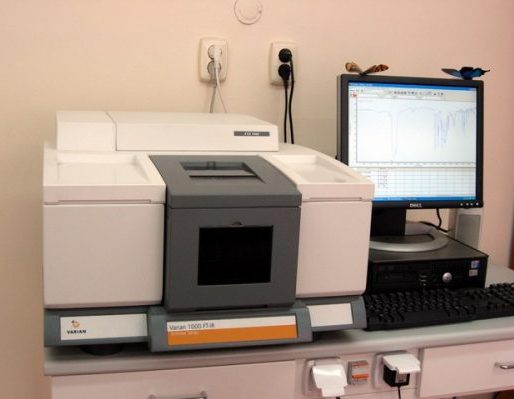
A to Z of IR Spectroscopy

A to Z of IR Spectroscopy
Click here to see other posts about FT-IR Click Here for AI-Powered Spectra Prediction & Professional Test Results Analysis Infrared (IR) spectroscopy is based on molecular vibrations caused by the oscillation of molecular dipoles. Bonds have characteristic vibrations depending on the atoms in the bond, the number of bonds and the orientation of those bonds with re...
Read more

Analysis and interpretation of Raman spectroscopy

Click here to see other posts about Raman spectroscopy Click Here for AI-Powered Spectra Prediction & Professional Test Results Analysis Raman Spectroscopy is a non-destructive chemical analysis technique which provides detailed information about chemical structure, phase and polymorphy, crystallinity and molecular interactions. It is based upon the interaction of ...
Read more

Fundamentals of Fourier Transform Infrared spectroscopy

Click here to see other posts about FT-IR Click Here for AI-Powered Spectra Prediction & Professional Test Results Analysis Infrared (IR) spectroscopy is a chemical analytical technique, which measures the infrared intensity versus wavelength (wavenumber) of light. Based upon the wavenumber, infrared light can be categorized as far infrared (4 ~ 400cm‐1), mid infr...
Read more

Steps of FTIR interpretation

Click here to see other posts about FT-IR 1. Determine the X-axis and the Y-axis of the spectrum. The X-axis of an IR spectrum is labeled as "Wavenumber" and ranges in number from 400 on the far right to 4,000 on the far left. The X-axis provides the absorption number. The Y-axis is labeled as "Percent Transmittance" and ranges in number from 0 on the bottom and 100 at...
Read more