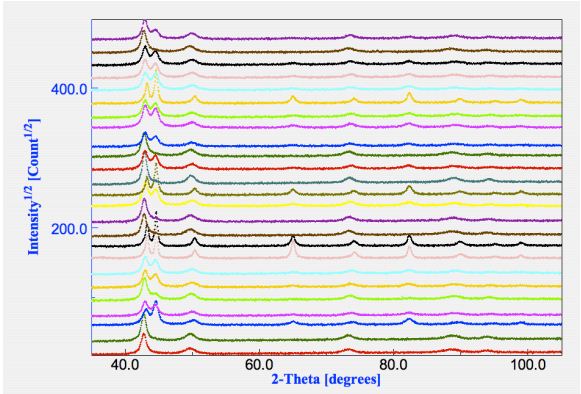
Quantitative Rietveld analysis in batch mode with Maud

Quantitative Rietveld analysis in batch mode with Maud
Click here to see other posts about XRD Click Here for AI-Powered Spectra Prediction & Professional Test Results Analysis 1. Introduction Today several instruments for fast spectra recording are available. In most cases the difficultyis to process and analyze the data quickly in a reliable way. The Maud program, in one of itsmany undocumented features, can be us...
Read more

Free reference card files for interpretation of XRD patterns using software

How to analyze “XRD” patterns?
Click here to see other posts about XRD Click Here for AI-Powered Spectra Prediction & Professional Test Results Analysis XRD is a non-destructive test method used to analyze the structure of crystalline materials. XRD analysis, by way of the study of the crystal structure, is used to identify the crystalline phases present in a material and the...
Read more

Free software for XPS interpretation

ree software for XPS interpretation
Click here to see other posts about XPS Click Here for AI-Powered Spectra Prediction & Professional Test Results Analysis XPST XPST is a program package for the analysis of X-ray Photoelectron Spectroscopy (XPS) data. It includes various graphical interfaces as well as commandline functions to facilitate the workup of XPS data. (more…...
Read more

Interpretation of XPS analysis

Interpretation of XPS analysis
Click here to see other posts about XPS Click Here for AI-Powered Spectra Prediction & Professional Test Results Analysis What is XPS? XPS is a surface-sensitive technique based on the photoelectric effect, which occurs when atoms or molecules are irradiated by photons of suitable energy, resulting in the ejection of electrons. The kinetic energy of the ejec...
Read more

A to Z of X-ray photoelectron spectroscopy (XPS)

A to Z of X-ray photoelectron spectroscopy (XPS)
Click here to see other posts about XPS Click Here for AI-Powered Spectra Prediction & Professional Test Results Analysis Introduction X-Ray photoelectron spectroscopy (XPS), also known as electron spectroscopy for chemical analysis (ESCA), is one of the most widely used surface techniques in materials science and chemistry. It allows the determination of atomi...
Read more

Fundamentals of XPS test

Fundamentals of XPS test
Click here to see other posts about XPS Click Here for AI-Powered Spectra Prediction & Professional Test Results Analysis Principle X-ray Photoelectron Spectroscopy (XPS) or Electron Spectroscopy for Chemical Analysis (ESCA) is a technique which analyzes the elements constituting the sample surface, its composition, and chemical bonding state by irradiating x-r...
Read more

Analysis and interpretation of Energy-Dispersive X-Ray Spectroscopy (EDS) results

Click here to see other posts about EDS Click Here for AI-Powered Spectra Prediction & Professional Test Results Analysis Interaction of an electron beam with a sample target produces a variety of emissions, including x-rays. An energy-dispersive (EDS) detector is used to separate the characteristic x-rays of different elements into an energy spectrum, and...
Read more

How to analyze “XRD” patterns?

How to analyze “XRD” patterns?
Click here to see other posts about XRD Click Here for AI-Powered Spectra Prediction & Professional Test Results Analysis X-ray diffraction (XRD) is a technique used in materials science for determining the atomic and molecular structure of a material. This is done by irradiating a sample of the material with incident X-rays and then measuring the intensities an...
Read more

How to analyze “XPS” spectra?

Click here to see other posts about XPS X-Ray photoelectron spectroscopy (XPS), also known as electron spectroscopy for chemical analysis (ESCA) is a non-destructive technique used to analyze the surface of a material. The XPS will measure the elemental composition, chemical state as well as the electronic state, thickness measurements of overlayers (up to 8nm), and wi...
Read more