Interpretation of XPS analysis

Interpretation of XPS analysis
Click here to see other posts about XPS Click Here for AI-Powered Spectra Prediction & Professional Test Results Analysis What is XPS? XPS is a surface-sensitive technique based on the photoelectric effect, which occurs when atoms or molecules are irradiated by photons of suitable energy, resulting in the ejection of electrons. The kinetic energy of the ejec...
Read more

A to Z of X-ray photoelectron spectroscopy (XPS)

A to Z of X-ray photoelectron spectroscopy (XPS)
Click here to see other posts about XPS Click Here for AI-Powered Spectra Prediction & Professional Test Results Analysis Introduction X-Ray photoelectron spectroscopy (XPS), also known as electron spectroscopy for chemical analysis (ESCA), is one of the most widely used surface techniques in materials science and chemistry. It allows the determination of atomi...
Read more

Fundamentals of XPS test

Fundamentals of XPS test
Click here to see other posts about XPS Click Here for AI-Powered Spectra Prediction & Professional Test Results Analysis Principle X-ray Photoelectron Spectroscopy (XPS) or Electron Spectroscopy for Chemical Analysis (ESCA) is a technique which analyzes the elements constituting the sample surface, its composition, and chemical bonding state by irradiating x-r...
Read more

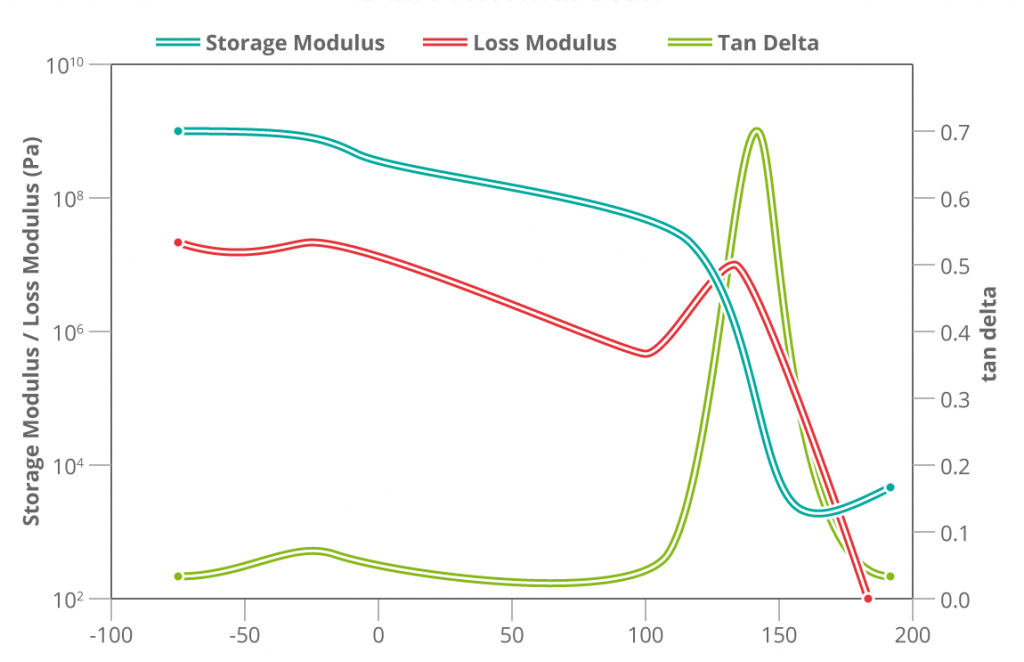
Fundamentals of DMTA analysis

Fundamentals of DMTA analysis
Click here to see other posts about DMA Click Here for AI-Powered Spectra Prediction & Professional Test Results Analysis Dynamic Mechanical Analysis or DMA for short, is an extremely versatile and flexible analytical technique for measuring the physical properties (incl: storage modulus, glass transition temperature, etc..) of a range of materials. Althoug...
Read more

A to Z of Dynamic Mechanical Analysis (DMA)

A to Z of Dynamic Mechanical Analysis (DMA)
Click here to see other posts about DMA Click Here for AI-Powered Spectra Prediction & Professional Test Results Analysis Dynamic mechanical analysis (DMA), also known as forced oscillatory measurements and dynamic rheology, is a basic tool used to measure the viscoelastic properties of materials (particularly polymers). To do so, DMA instrument applies an oscillat...
Read more

Analysis and interpretation of Energy-Dispersive X-Ray Spectroscopy (EDS) results

Click here to see other posts about EDS Click Here for AI-Powered Spectra Prediction & Professional Test Results Analysis Interaction of an electron beam with a sample target produces a variety of emissions, including x-rays. An energy-dispersive (EDS) detector is used to separate the characteristic x-rays of different elements into an energy spectrum, and...
Read more

Analysis and interpretation of thermogravimetric analysis (TGA) results

Click here to see other posts about TGA/DTG Click Here for AI-Powered Spectra Prediction & Professional Test Results Analysis TGA is a powerful and robust technique to explore the thermal stability of a material. By accurately monitoring the weight of a sample while heating at a constant rate, we can measure changes in a sample’s weight and attribute this to a spec...
Read more

Analysis and interpretation of atomic force microscopy (AFM) results

Click here to see other posts about AFM Click Here for AI-Powered Spectra Prediction & Professional Test Results Analysis Atomic force microscopy (AFM) or scanning force microscopy (SFM) is a very-high-resolution type of scanning probe microscopy (SPM), with demonstrated resolution on the order of fractions of a nanometer, more than 1000 times better than the o...
Read more

The principle of Transmission Electron Microscope (TEM)

Click here to see other posts about TEM Click Here for AI-Powered Spectra Prediction & Professional Test Results Analysis To satisfy this curiosity, many inventions have been devised. One of them is the optical microscope. The human eye can distinguish objects down to about 0.2 mm. Optical microscopes reveal small objects, which would be otherwise invisible to the ...
Read more

A to Z of scanning electron microscopy (SEM)

Click here to see other posts about SEM Click Here for AI-Powered Spectra Prediction & Professional Test Results Analysis The scanning electron microscope (SEM) uses a focused beam of high-energy electrons to generate a variety of signals at the surface of solid specimens. The signals that derive from electron-sample interactions reveal information about...
Read more